Almost every English-language guide will tell you Myeongdong Kyoja (명동교자) is the kalguksu spot in Seoul. That part is true. What most of them miss is the small stuff — that there are two branches a few minutes apart, that the menu is exactly four items and has been for nearly 60 years, and that the dish everyone photographs (the dumplings) is not actually the best thing on the table. So this isn’t a “first kalguksu in Seoul” intro post. It’s the notes I’d send to a friend who’s about to walk in.
A bit of context first. For Koreans, kalguksu is cold-weather food. The first time the wind turns sharp in November, or you get caught in autumn rain on the way home, this is the bowl that pops into your head — soft hand-cut wheat noodles in a deep, slightly milky broth that warms you back up before you’ve even taken your coat off. Myeongdong Kyoja has been doing exactly this since 1966, three generations of the same family, packed almost every day for nearly 60 years. Myeongdong isn’t really my neighborhood, so I’m not a weekly regular — but every time the craving hits, this is the bowl I end up thinking about.
The line moves faster than it looks
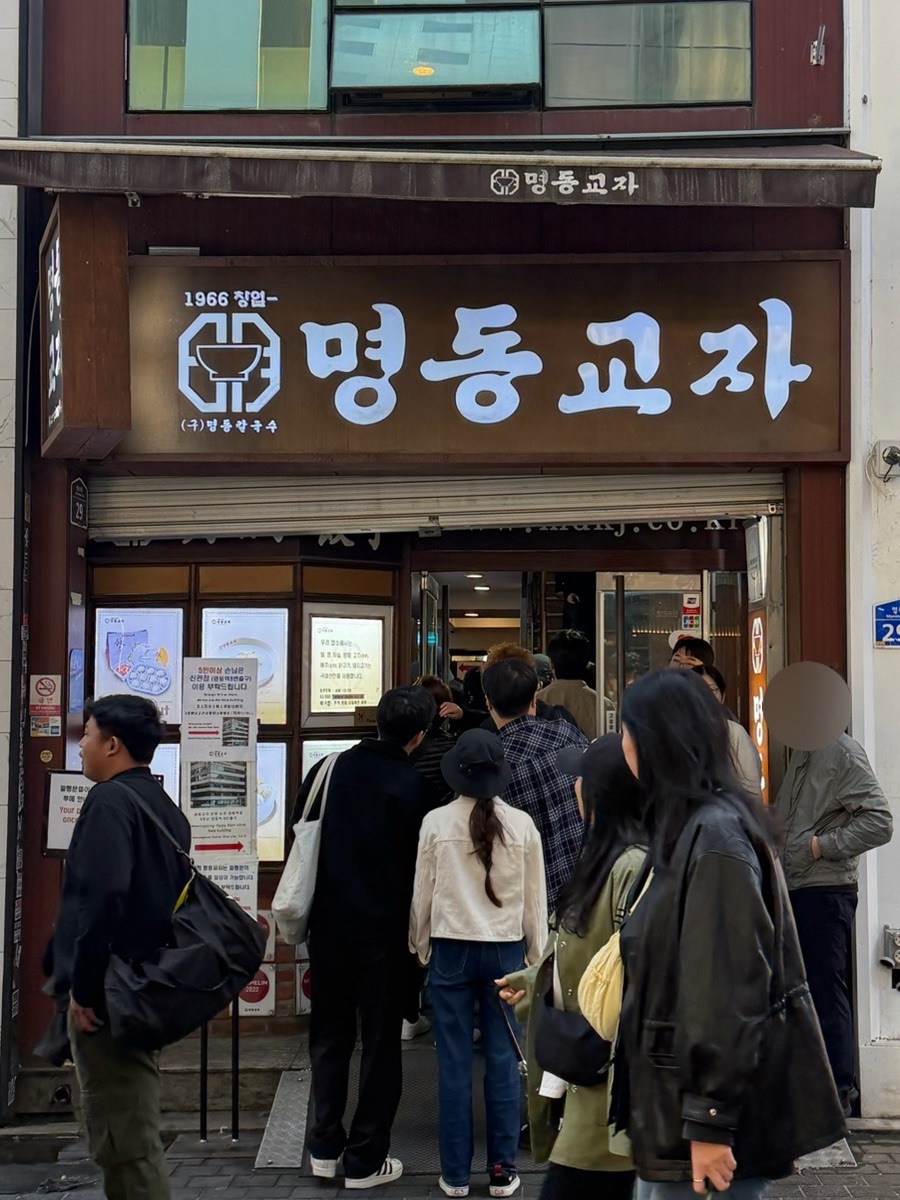
I walked up to Myeongdong Kyoja and the line outside looked long enough to make me hesitate. But here’s the thing about this place — the staff inside is moving people through so fast that the line you see and the wait you actually do are not the same number. I was at a table within minutes.
The Annex — there’s a second branch most foreigners miss
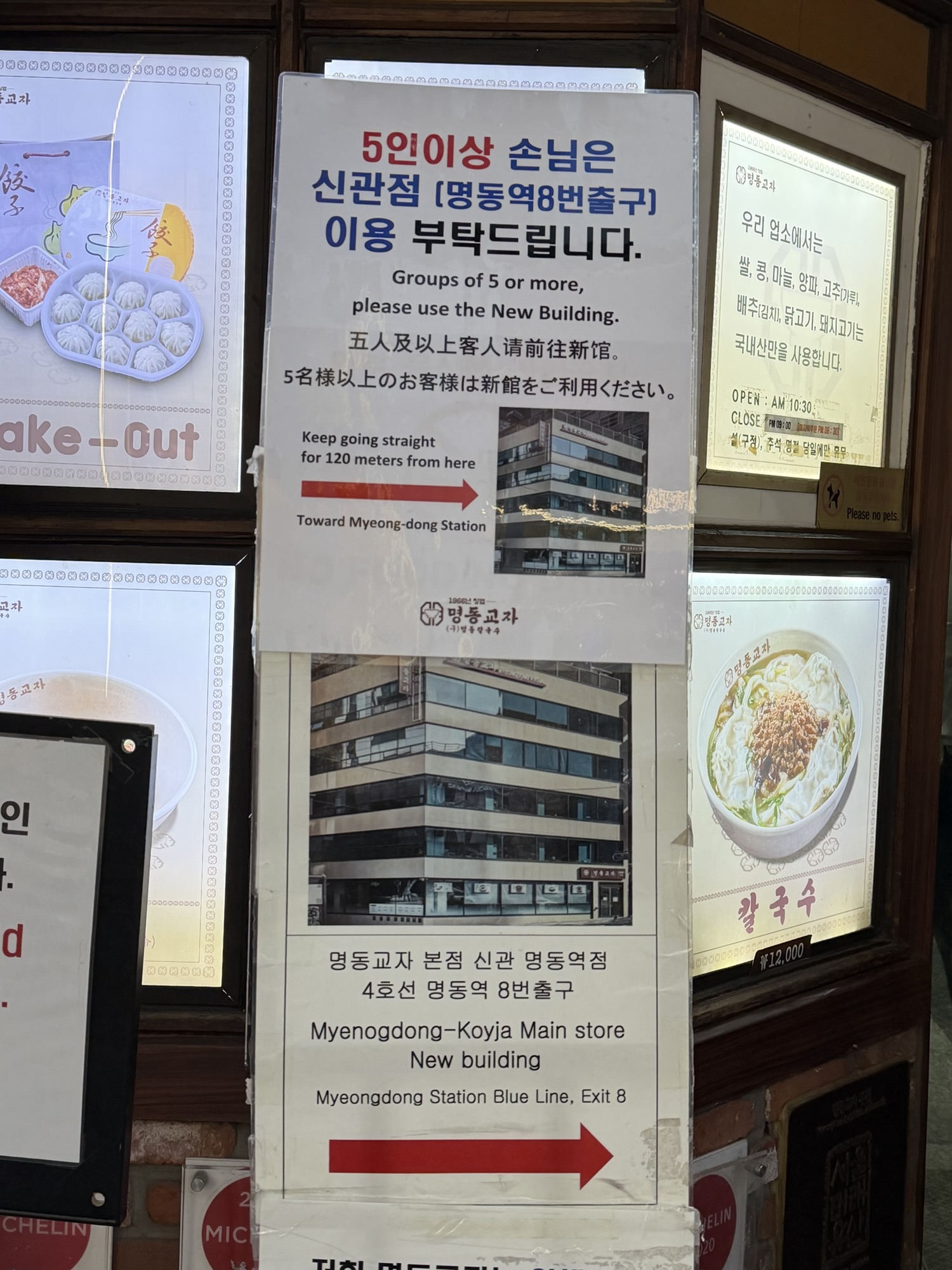
There’s a second branch about 120 meters from the main entrance, in the direction of Myeongdong Station Exit 8 — the Annex (신관). Same restaurant, same menu, same kitchen, but the building is newer and the dining room is wider, with tables spaced like an actual restaurant instead of a packed lunchbox. Groups of five or more get routed there by default — the sign right at the main entrance spells it out in Korean, English, Chinese, and Japanese. If you’re three or four and don’t mind another minute of walking, the Annex looks like the more comfortable meal.
Two house rules at the entrance
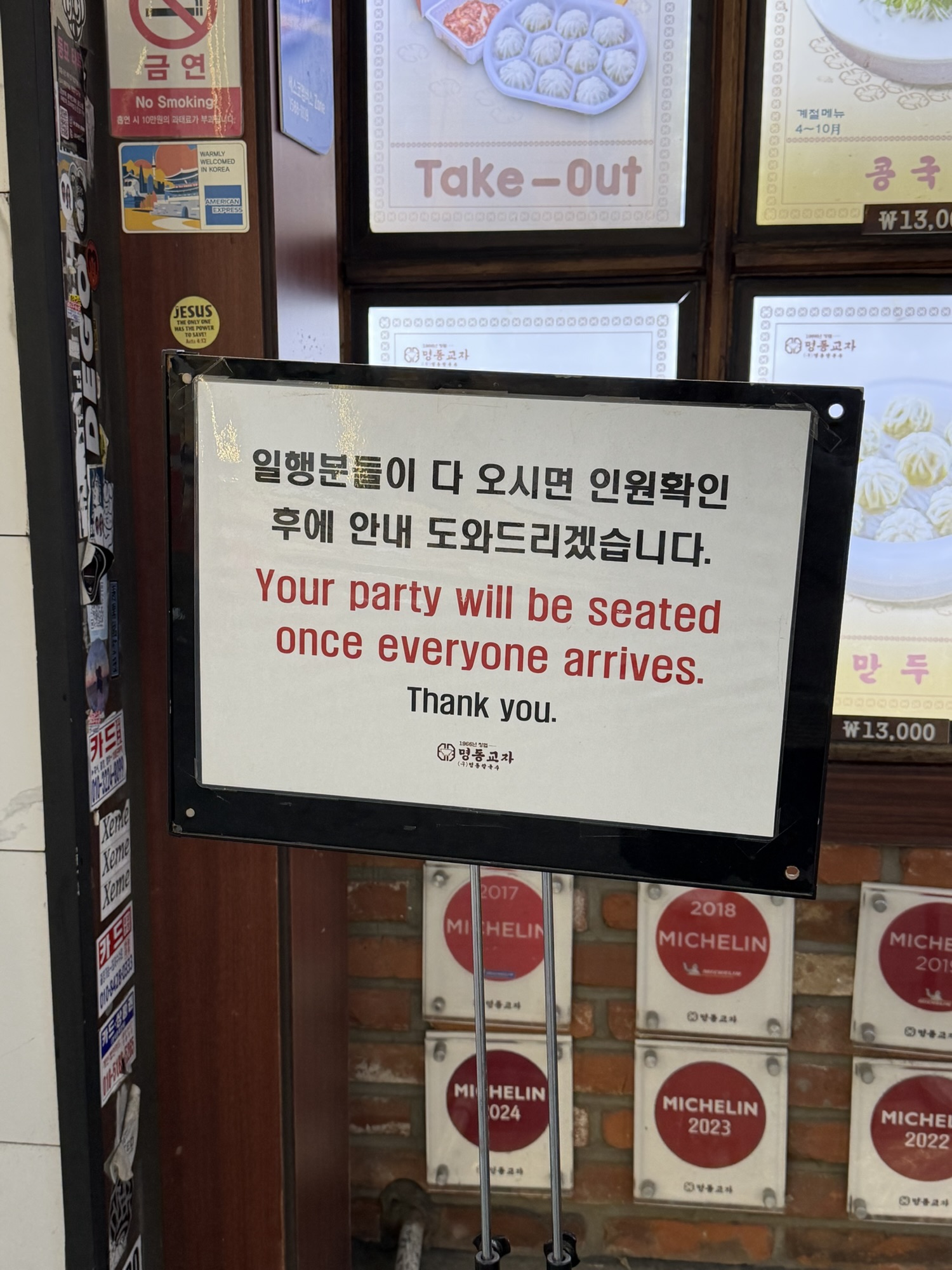
First, your party will not be seated until everyone has arrived. There’s a sign about this right at the entrance, in Korean and English. Don’t send one person ahead to “hold a spot” — that’s not how it works.
Second, this is not a leisurely sit-down dinner. Service moves at a pace that I think genuinely surprises tourists. You order at the counter, pay on the spot — payment happens immediately when you order, not at the end of the meal — then sit down. Water and kimchi are self-serve at the table, and your kalguksu lands in front of you before your phone has time to die. That’s why the line clears faster than it looks.
Inside: tight tables, two floors, all business
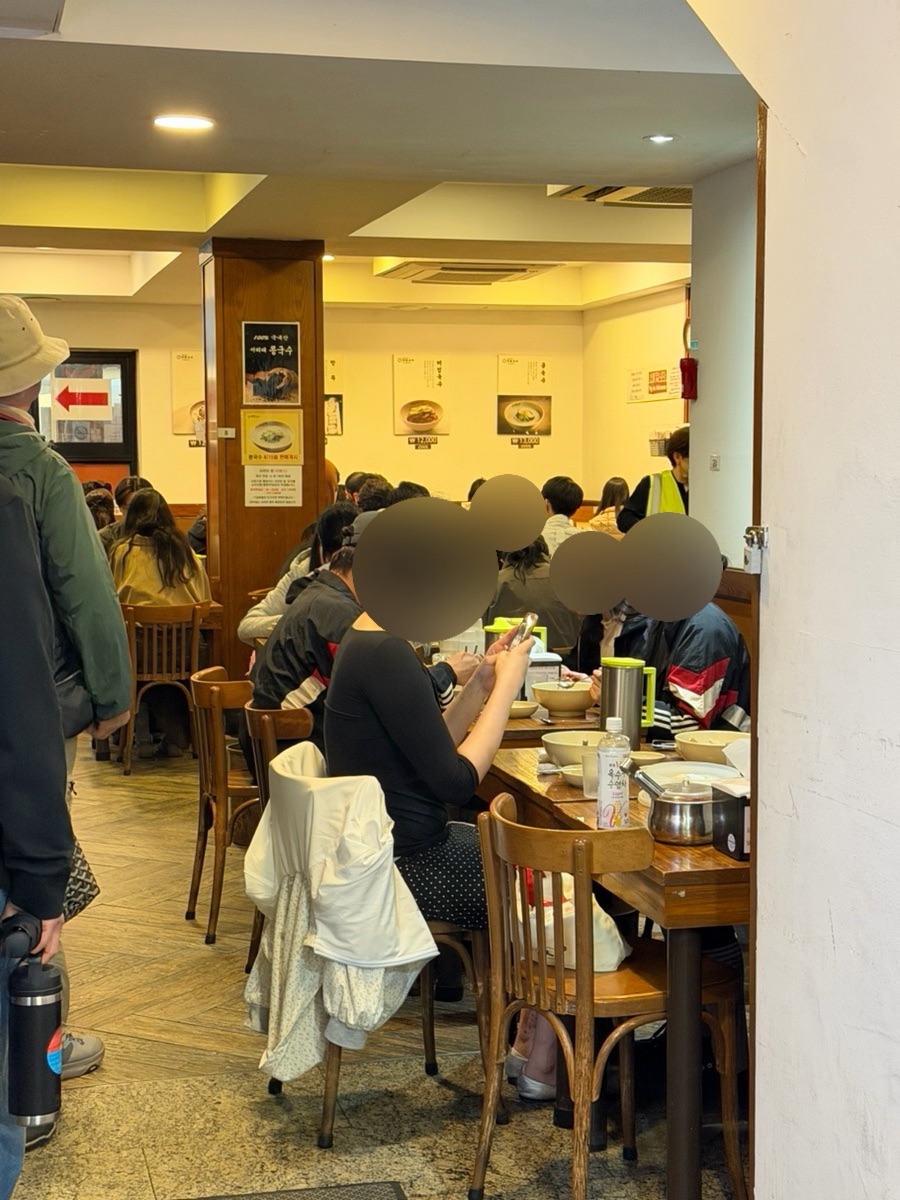
The first floor is the original dining room. Wooden tables packed close enough that you’ll bump elbows with a stranger if you stretch. Lighting is warm but utilitarian — nobody is here for the ambiance, they’re here for noodles. There’s a steady rhythm of bowls landing, chopsticks moving, plates being cleared. It feels like a working restaurant, which is exactly what I want from a place that’s been doing one thing for nearly 60 years.
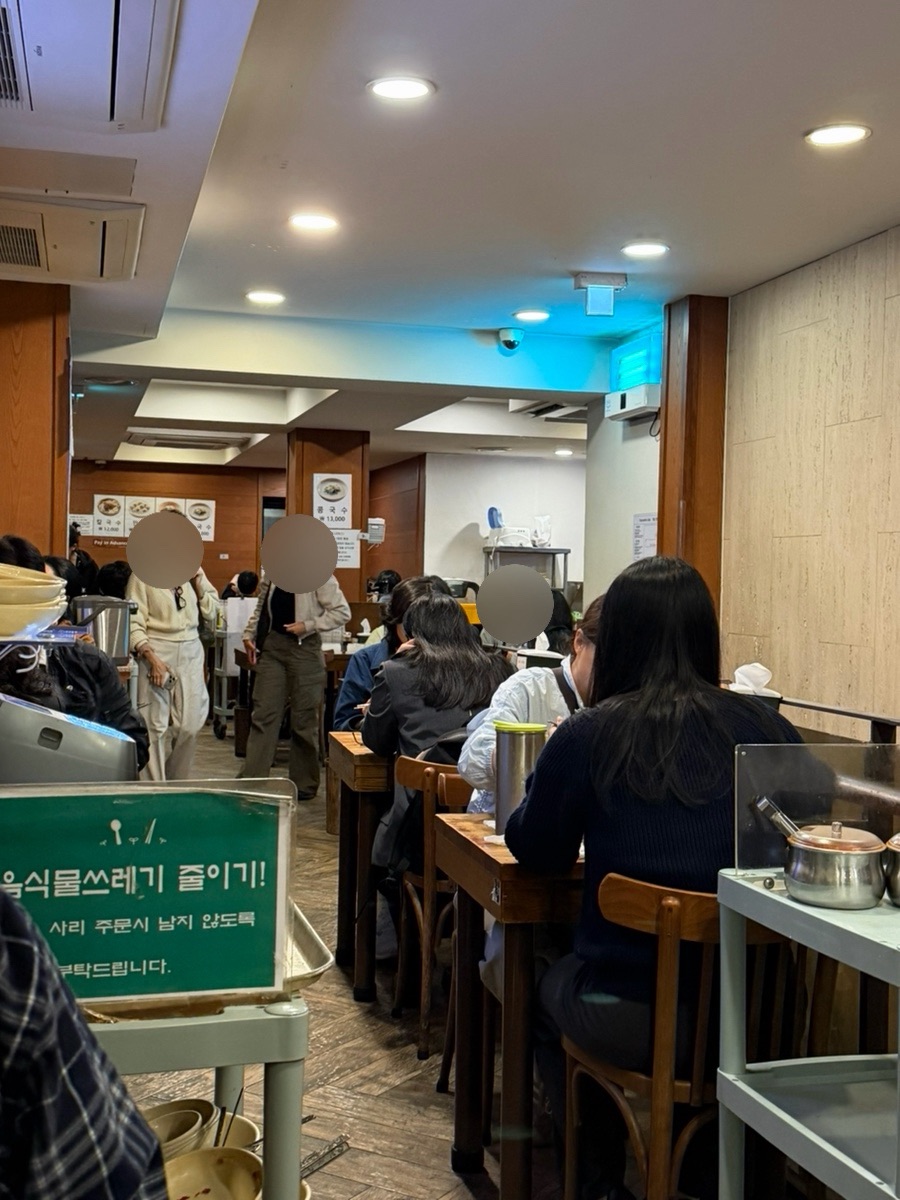
The second floor is the same energy with a slightly different ceiling. Whether you’re upstairs or downstairs is luck of the draw — the staff seats you wherever opens up first.
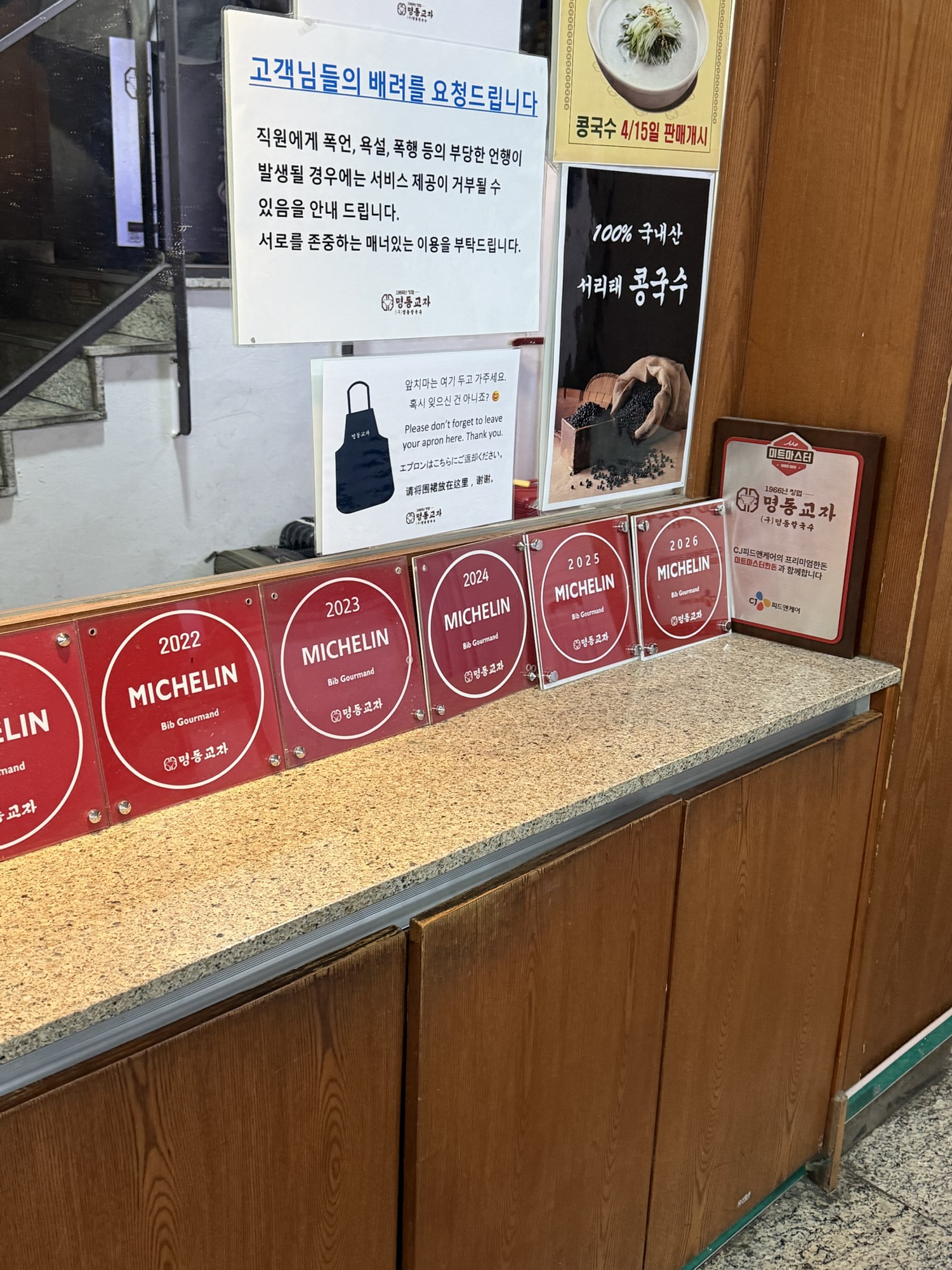
One detail I noticed at the entrance — they have a wall of Michelin Guide plaques going back nearly a decade. They’ve been a Bib Gourmand fixture, which is the Michelin category for places that are excellent but not fine-dining priced. That feels accurate for this restaurant.
The menu is four items. That’s the whole list.
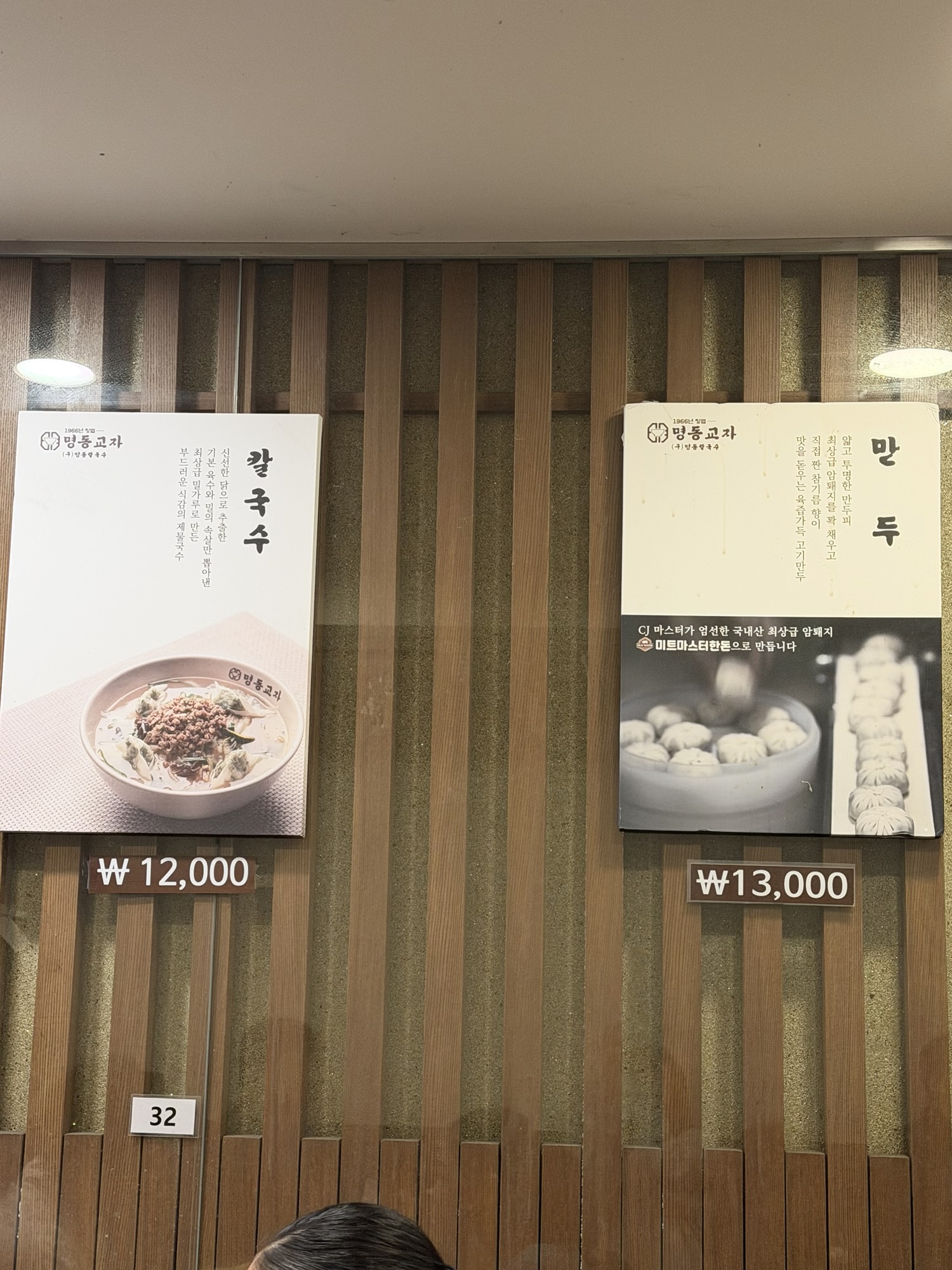
Kalguksu, mandu, bibim-guksu, kongguksu. Twelve to thirteen thousand won each. That’s it. No appetizers, no side dishes you order separately, no “chef’s special.” In Seoul, where restaurant menus tend to balloon over time to chase trends, this kind of restraint is almost unheard of.
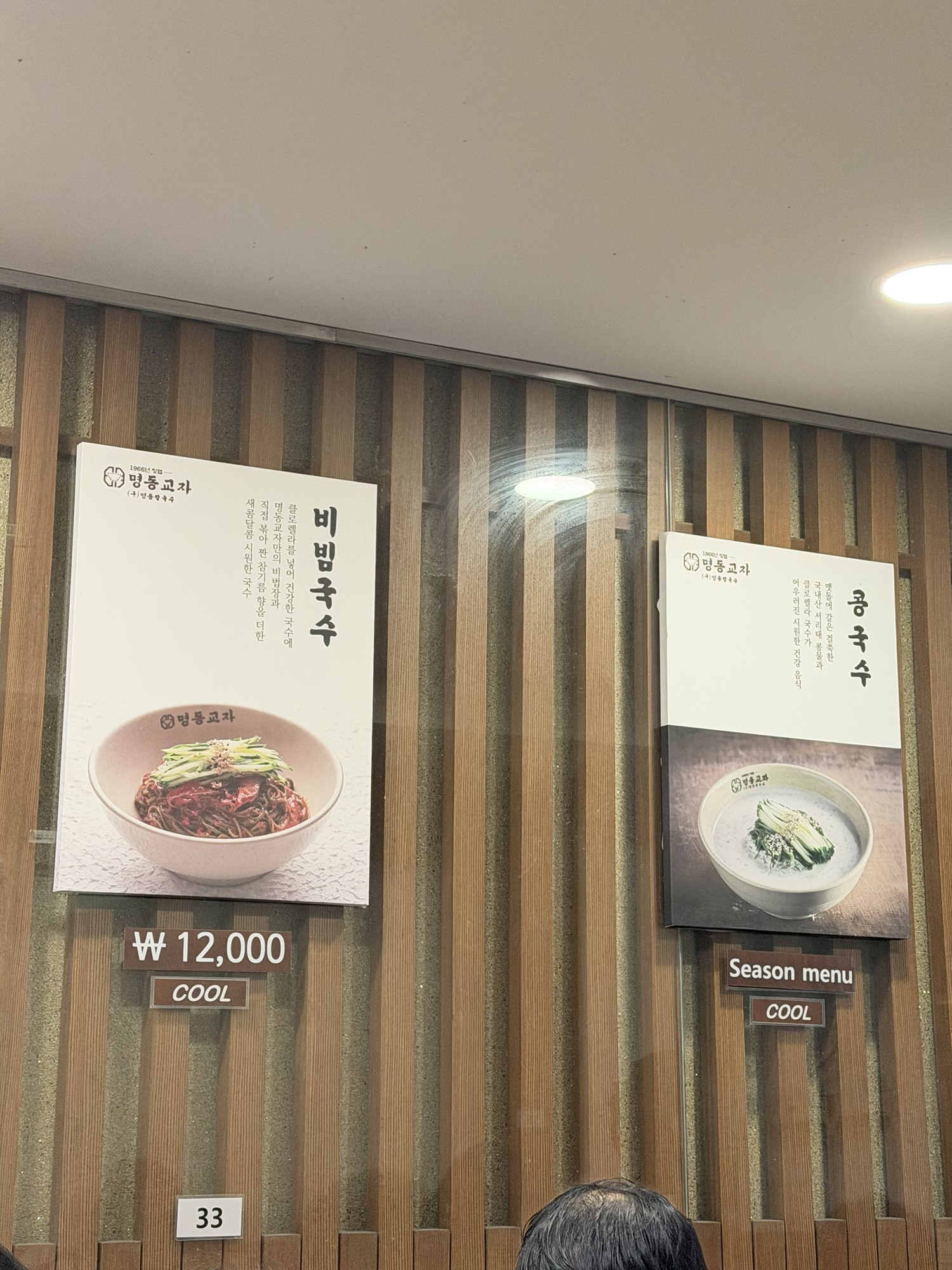
The bibim-guksu is cold spicy noodles tossed in gochujang sauce. The kongguksu is the cold soybean-broth noodle dish — that one’s seasonal, usually mid-April through October, so the menu drops to three items in the colder months. For a first visit, the kalguksu is the obvious order. It’s the dish the place was built around, and it’s what almost everyone at every table is eating.
The free add-on rule nobody tells tourists about
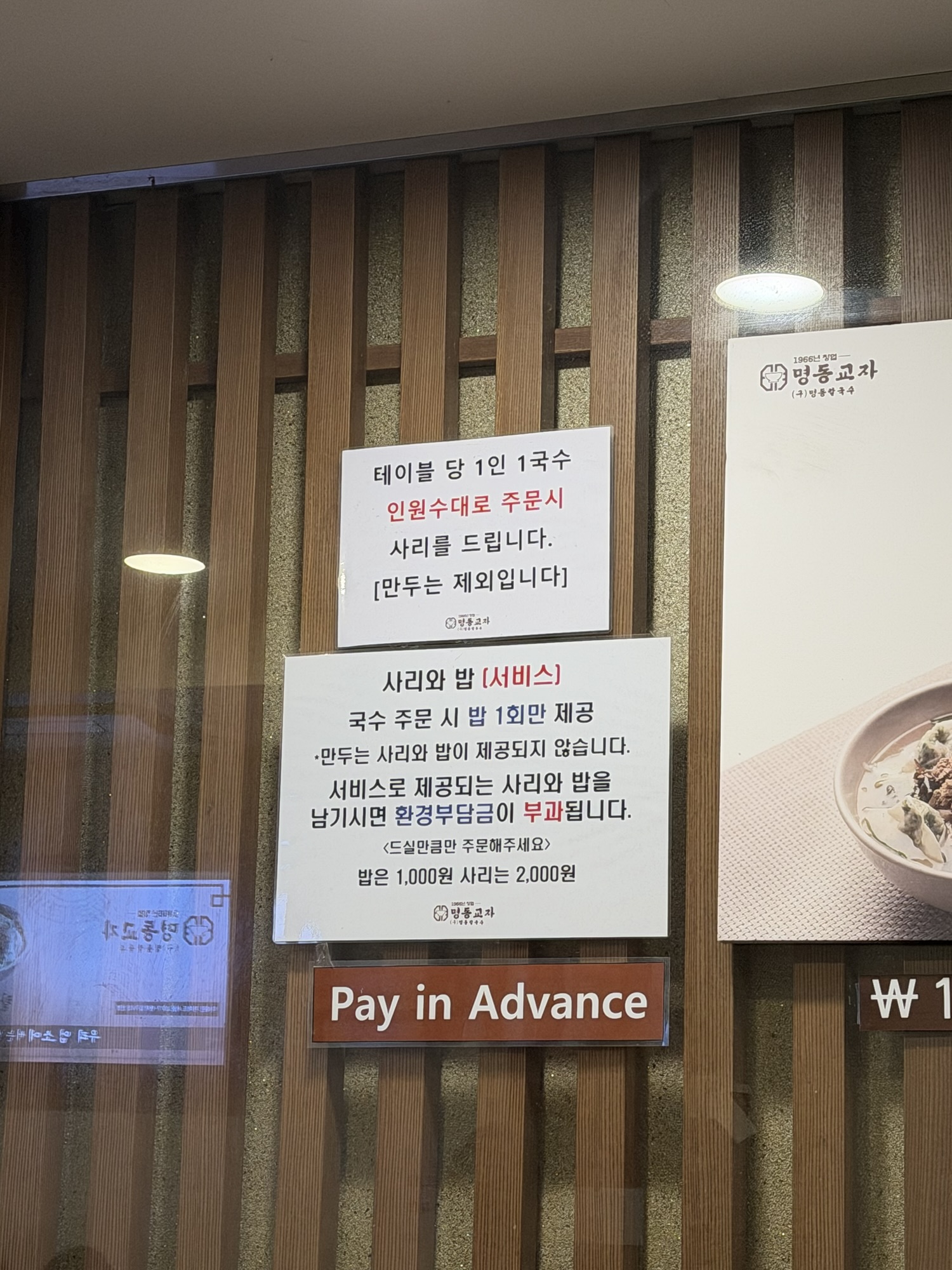
This is the kind of thing that gets buried in a Korean-only sign on the wall but matters a lot if you’re trying to eat well here. If you order a noodle dish (kalguksu or bibim-guksu), you get one free sari — extra noodles to dunk in the leftover broth — and one free small bowl of rice, also intended for the broth. Want a second round? Sari is 2,000 won extra, rice is 1,000 won. Mandu-only orders don’t qualify for either freebie. And the kitchen really doesn’t want you wasting these add-ons — there’s an environmental fee for leftovers. The sign is very specific about all of this.
So the Korean-style move at this restaurant is: order kalguksu, eat the noodles, drink some broth, ask for sari, eat that, then ask for rice and pour it into whatever broth is left. Three rounds out of one bowl. Most tourists I’ve seen here finish the kalguksu and pay the bill, missing two-thirds of what they could have eaten for the same price. Just know it’s there.
The table is set before you sit down
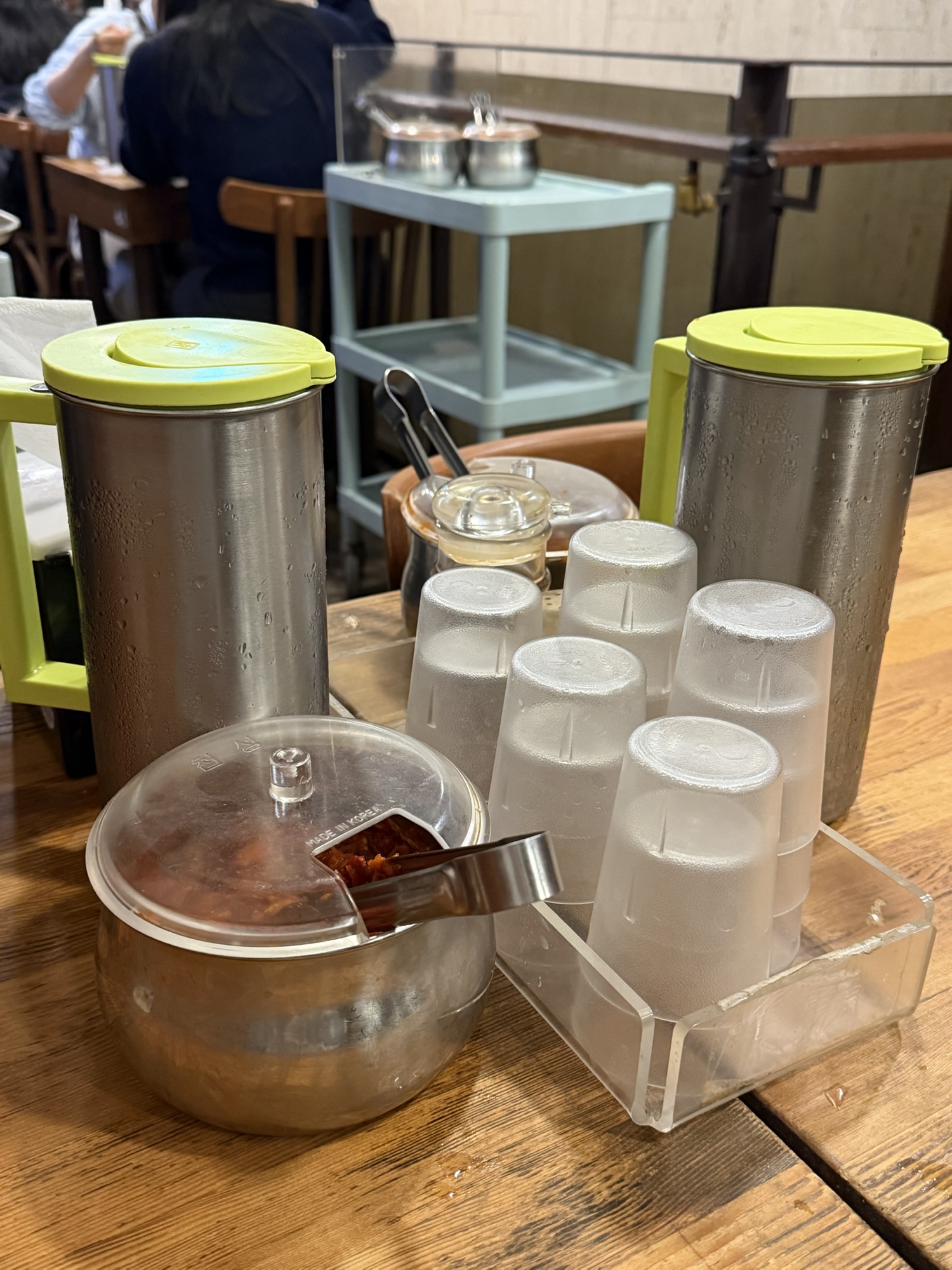
Every table has the same setup. Two stainless steel water pitchers (refill yourself), a stack of frosted plastic cups, a small jar of garlic kimchi with serving tongs, and a white pepper shaker. That’s it. No menus laid out — the menu is on the wall.
The kalguksu — soft noodles, deep broth, surprise dumplings
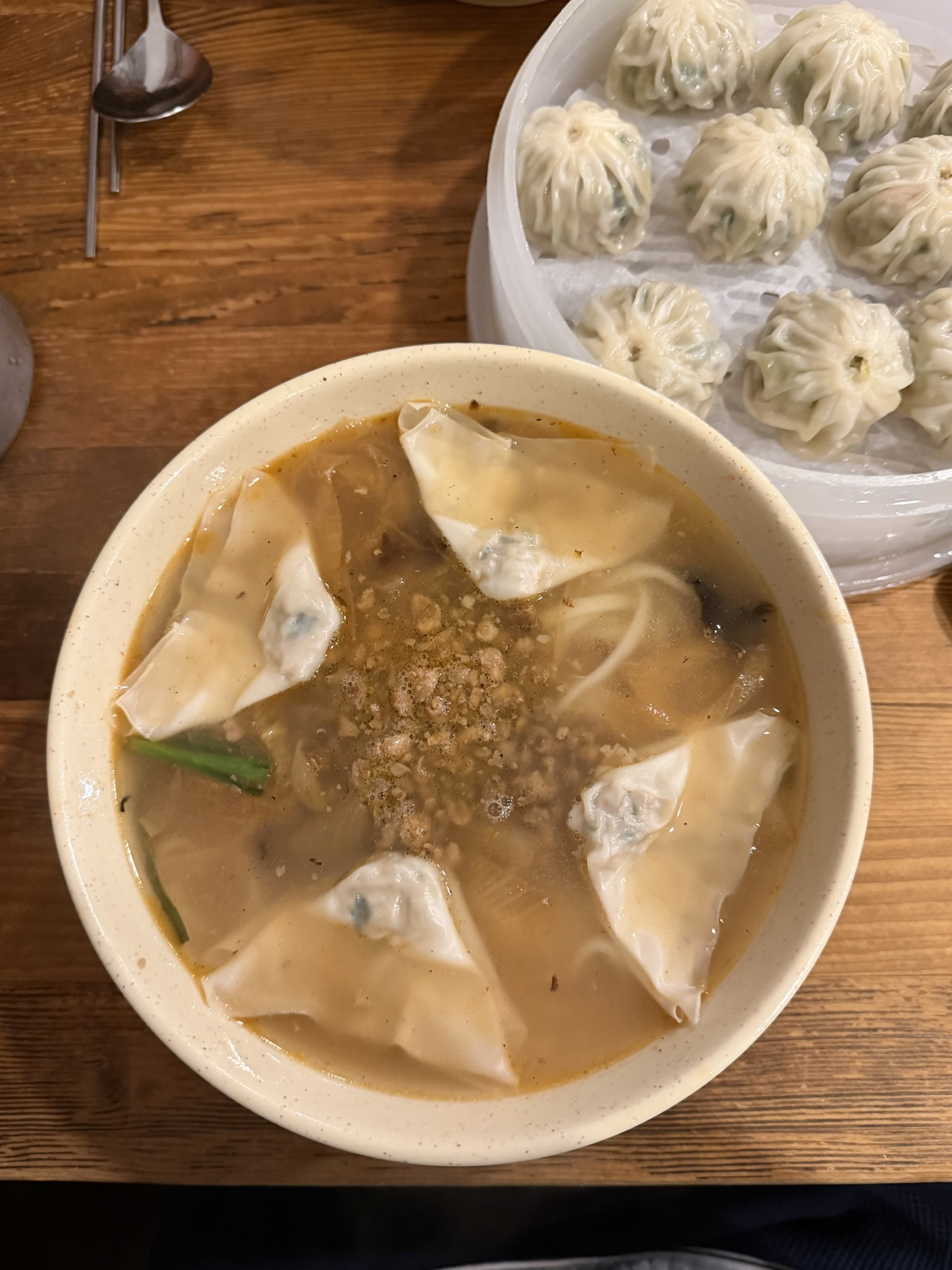
The bowl arrives so fast it almost throws off your timing. Wide ceramic bowl, amber broth, hand-cut wheat noodles peeking through, a layer of seasoned ground pork on top. And — here’s the part nobody mentions in English reviews — there are four small mandu floating in the soup. You order kalguksu and you get little dumplings as a freebie, tucked right into the bowl.
The noodles are soft. Not chewy-firm like a ramyeon, not slippery like a soba. They’re hand-cut wheat noodles with a tender bite, and the broth — which is rich without being heavy — coats every strand. Korean reviewers describe the broth as having real depth from pork and anchovy stock, and that tracks. The ground pork on top adds something almost meaty-buttery as it dissolves into the soup.
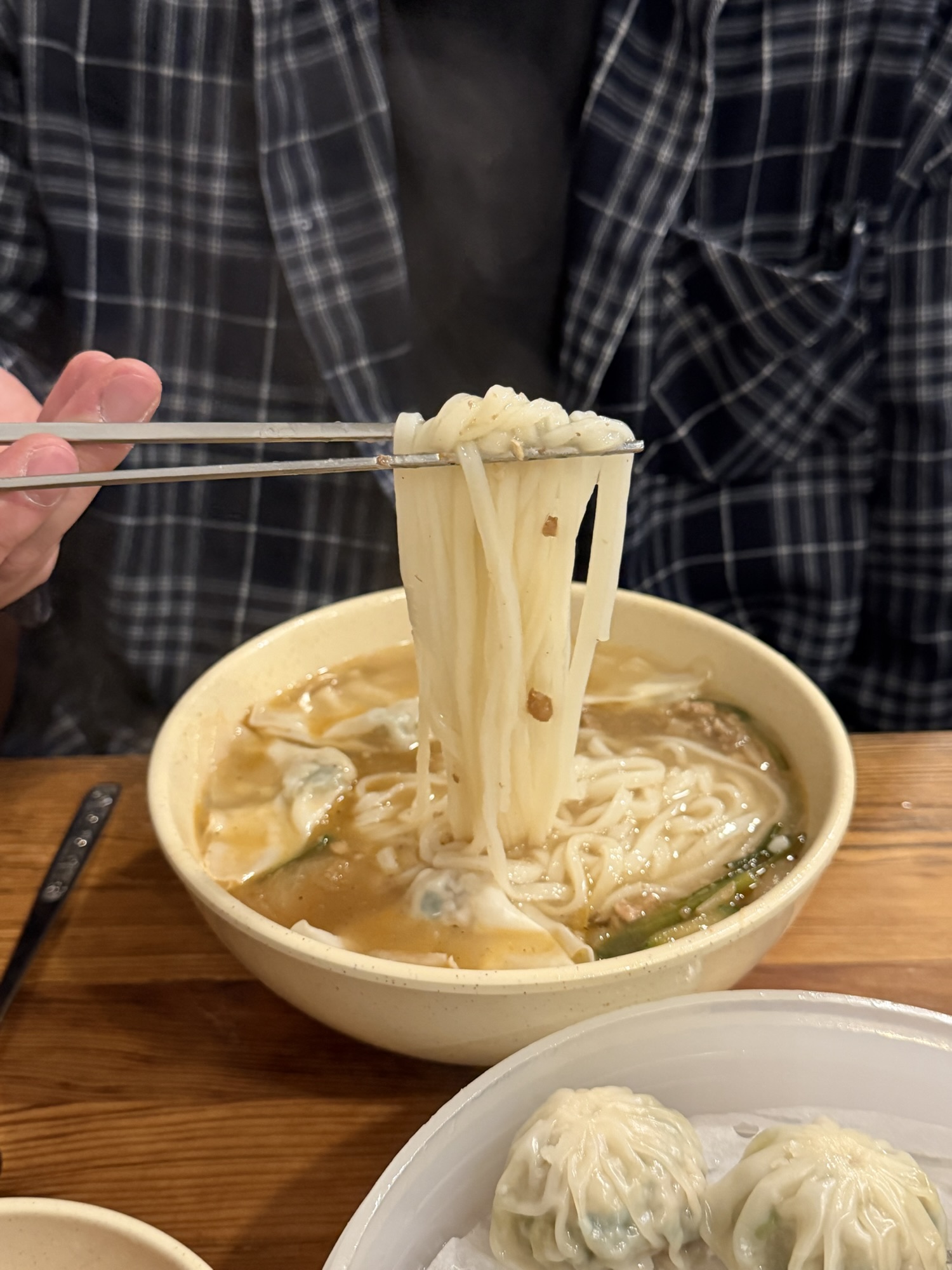
By the third spoonful, you start to understand why this place has been packed for nearly 60 years. Nothing about it is showy — the broth is dialed in, the noodles tender, the pork slowly dissolving into the soup. It just gets every part right.
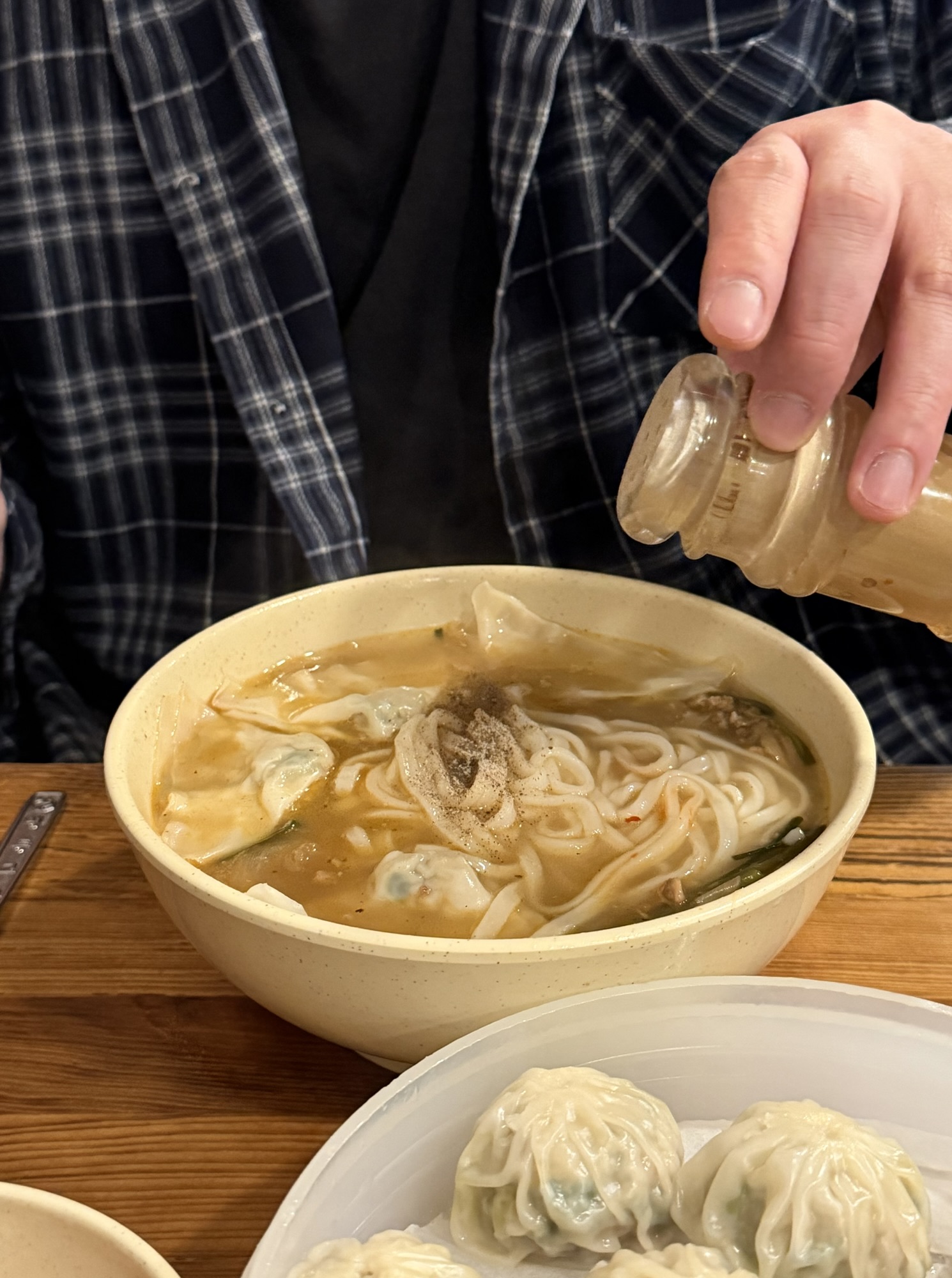
One small tip: if the broth tastes a touch under-seasoned to you (Western palates sometimes find Korean broths gentler than expected), the white pepper on the table is exactly the move. A few twists transforms it. Don’t reach for the soy sauce first — pepper is what the locals do.
The garlic kimchi is the actual headliner
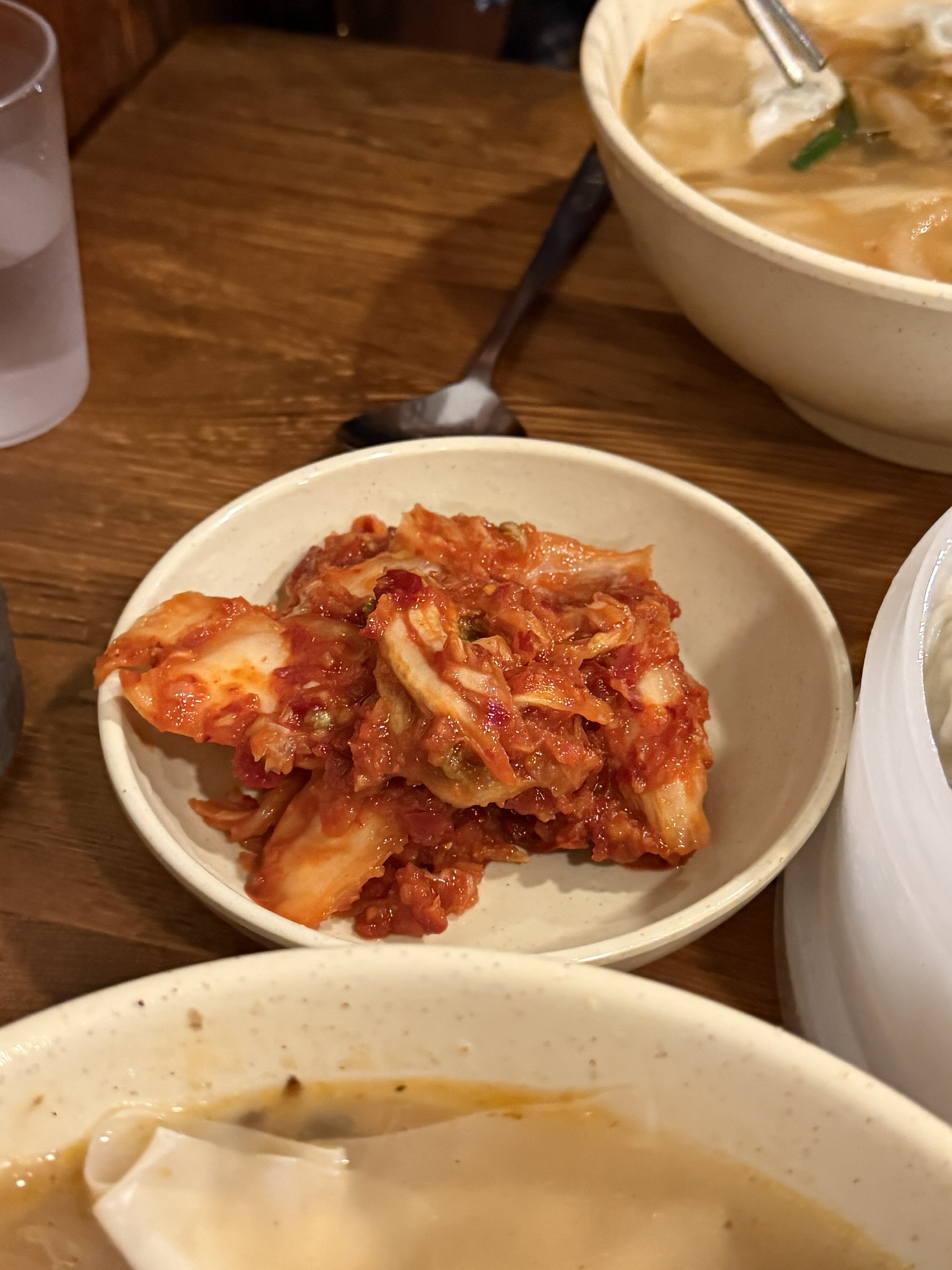
Okay, here’s where I’d disagree with most English-language coverage of this place. They focus on the dumplings. The kalguksu is great. But the thing Korean reviewers consistently lose their minds over — and the thing that, after this meal, I now understand — is the 마늘김치. Garlic kimchi.
It’s small-cut napa cabbage in a punchy red gochugaru sauce loaded with garlic. It’s served free, in a small dish at every table, and you can refill it freely. It’s intensely garlicky and properly spicy — the first bite can be a lot if you didn’t grow up eating this. And it’s exactly what the mellow broth needs to balance out.
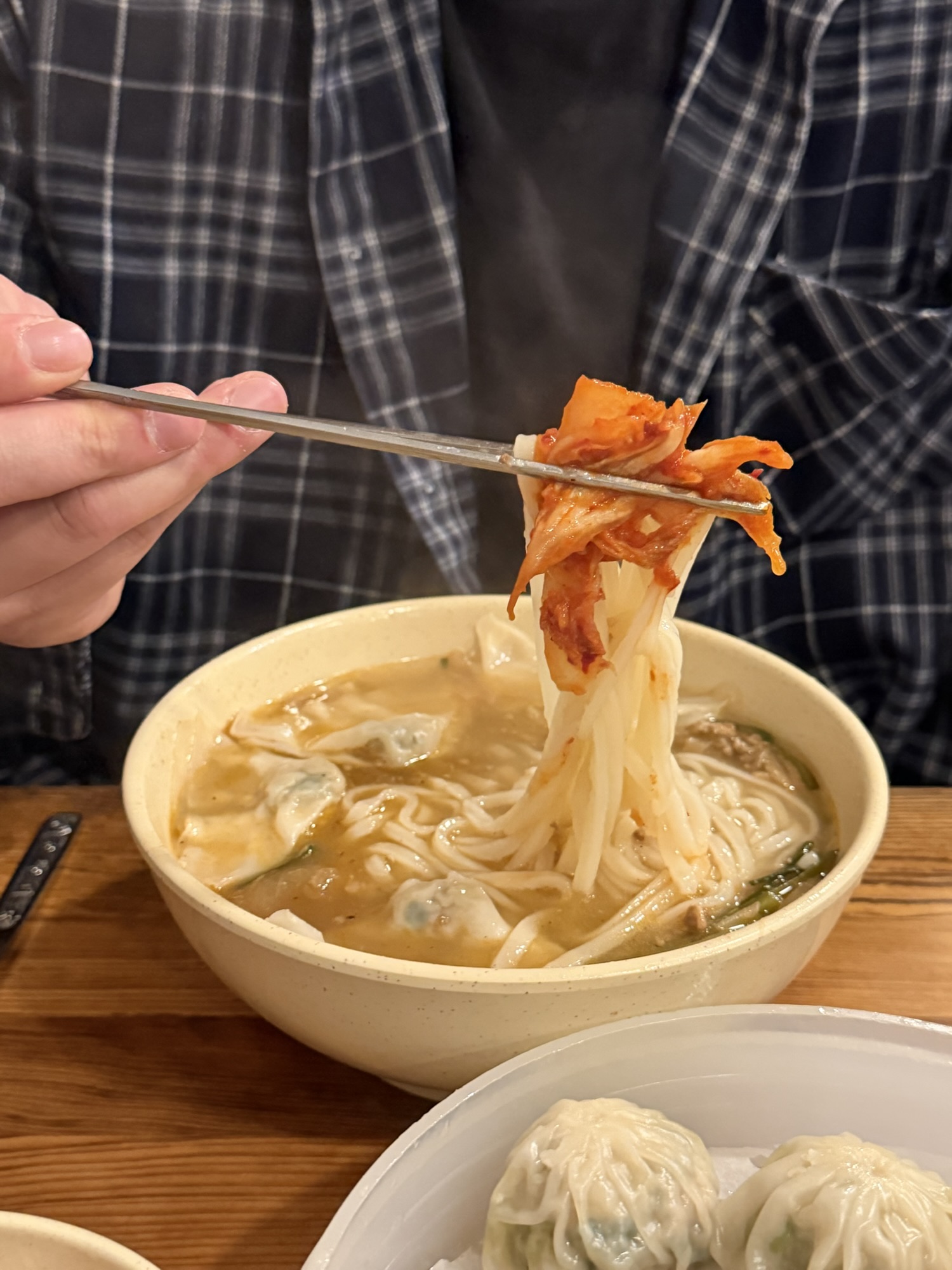
Try this: lift a chopstickful of kalguksu noodles, drape some garlic kimchi over the top, eat it together. The contrast of the soft noodles, the fatty broth, and the bright pungent kimchi is genuinely the best bite of the meal. If you came here for the dumplings, fine — but order the kalguksu specifically so you get to do this combination.
The mandu — solid, not the reason to come
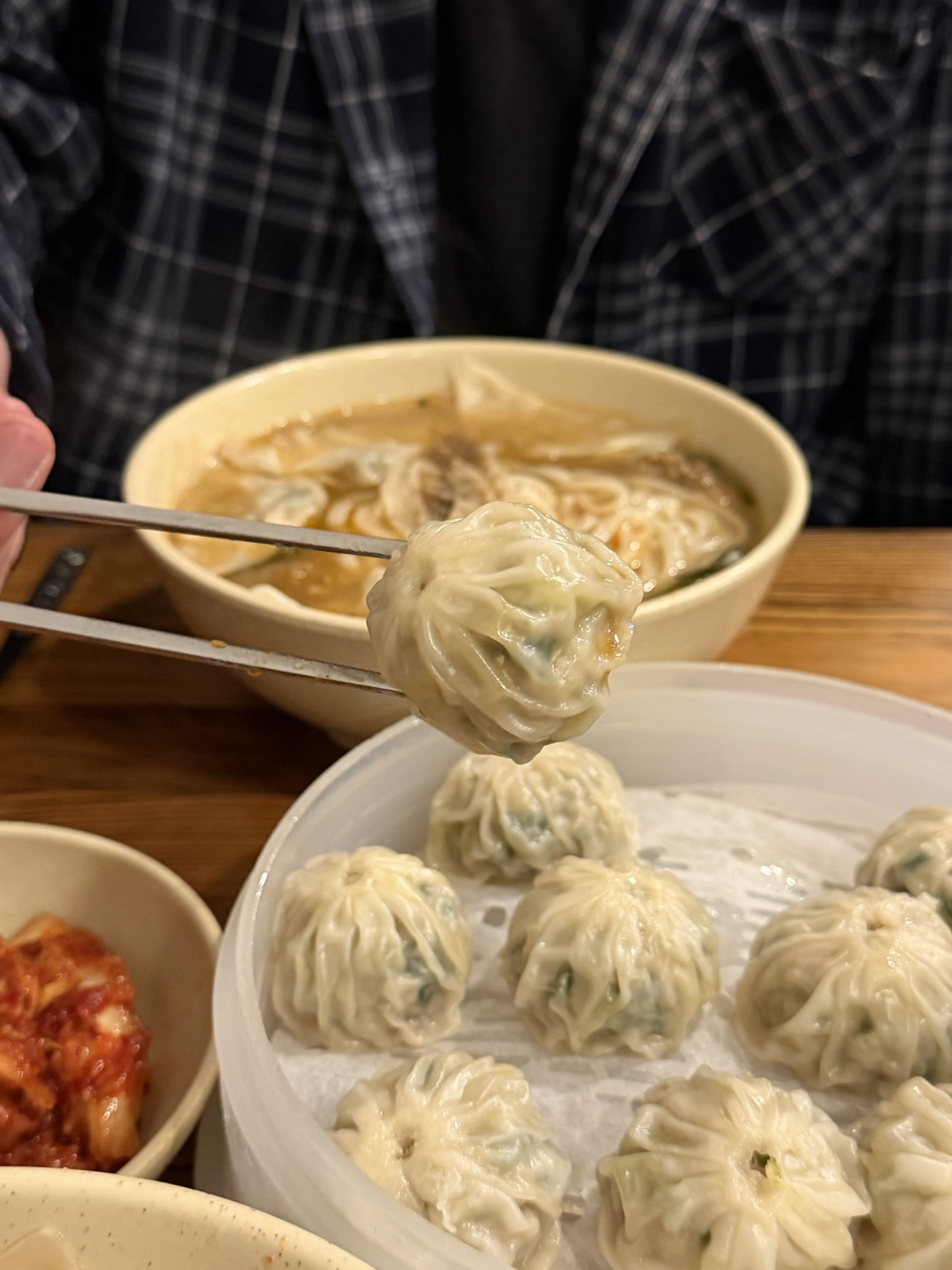
The mandu plate comes with ten bite-sized steamed dumplings, served on a parchment-lined steamer plate. They’re pleated, pale, smaller than the doorstop king-mandu some Korean places do. Same filling, by the way, as the small mandu in the kalguksu — so if you order both dishes, you’re eating the same dumpling twice in two formats.
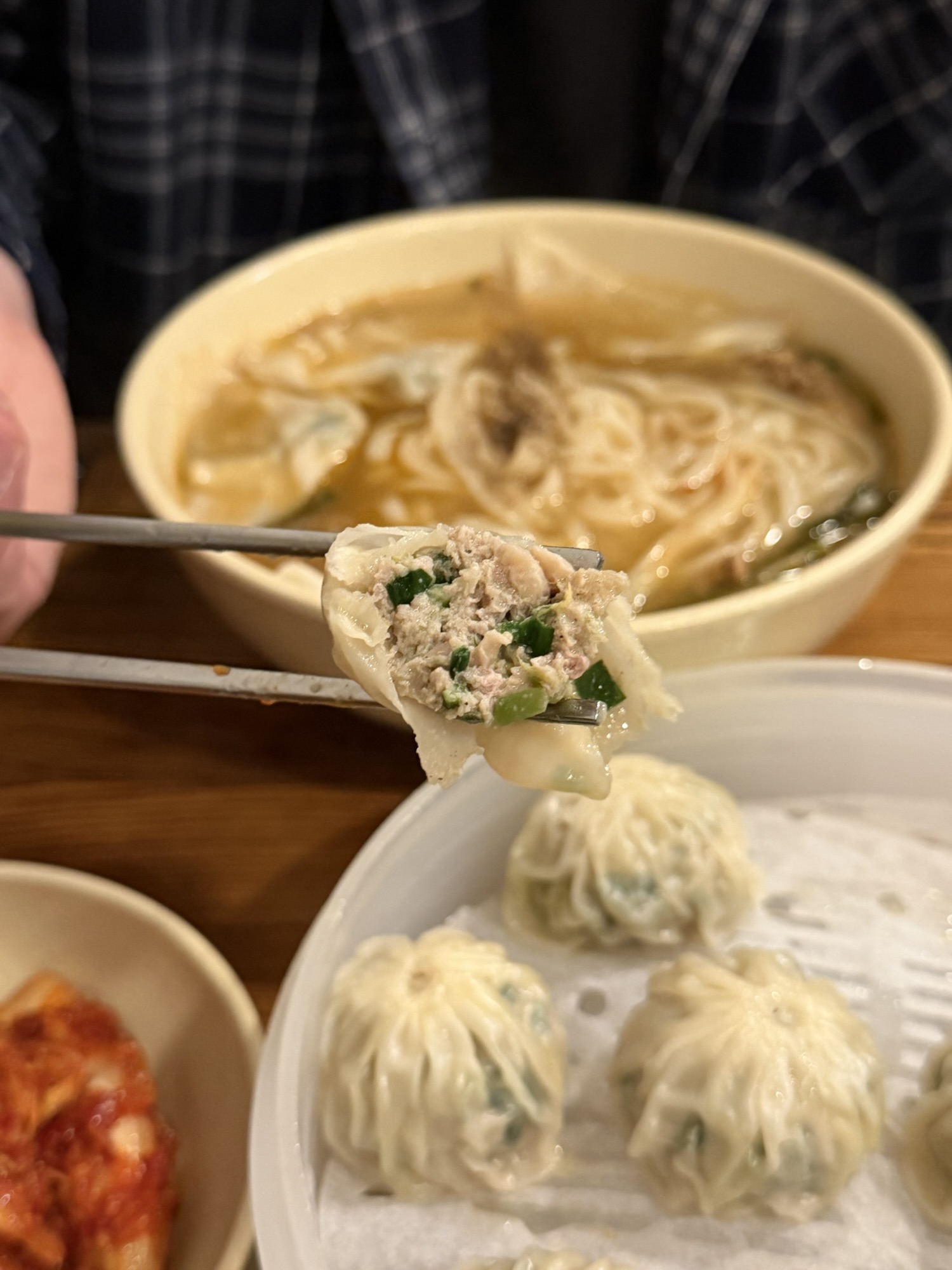
Bite open one and the filling is mostly ground pork with a little chive. It’s well-seasoned and clean-tasting, but it’s not a transcendent dumpling — Korean reviewers will tell you the same thing. If I came back, I’m not sure I’d order the mandu plate again — it’s perfectly fine, but a little redundant once you’ve already got mandu floating in your kalguksu. The plate is 13,000 won, which is fair, but the kalguksu does more for less.
The sari and rice round — finish strong
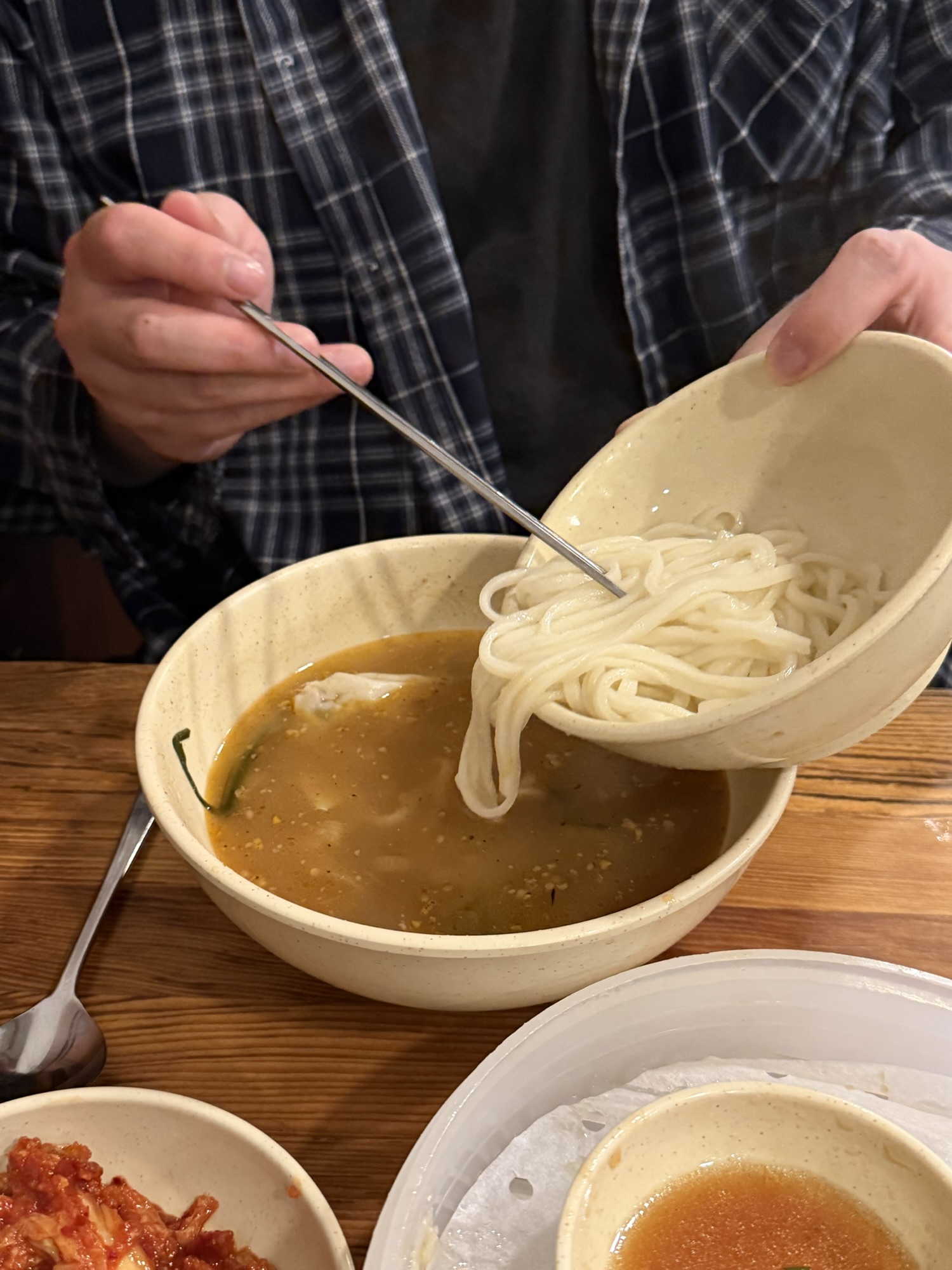
About two-thirds through the kalguksu, ask for sari. A small bowl of plain noodles arrives, and you tip them into the broth that’s left. The noodles soak up the seasoning that’s intensified at the bottom of the bowl, and you basically get a smaller, more concentrated round two. This part is free with your noodle order, and skipping it feels like leaving a meal half-eaten.
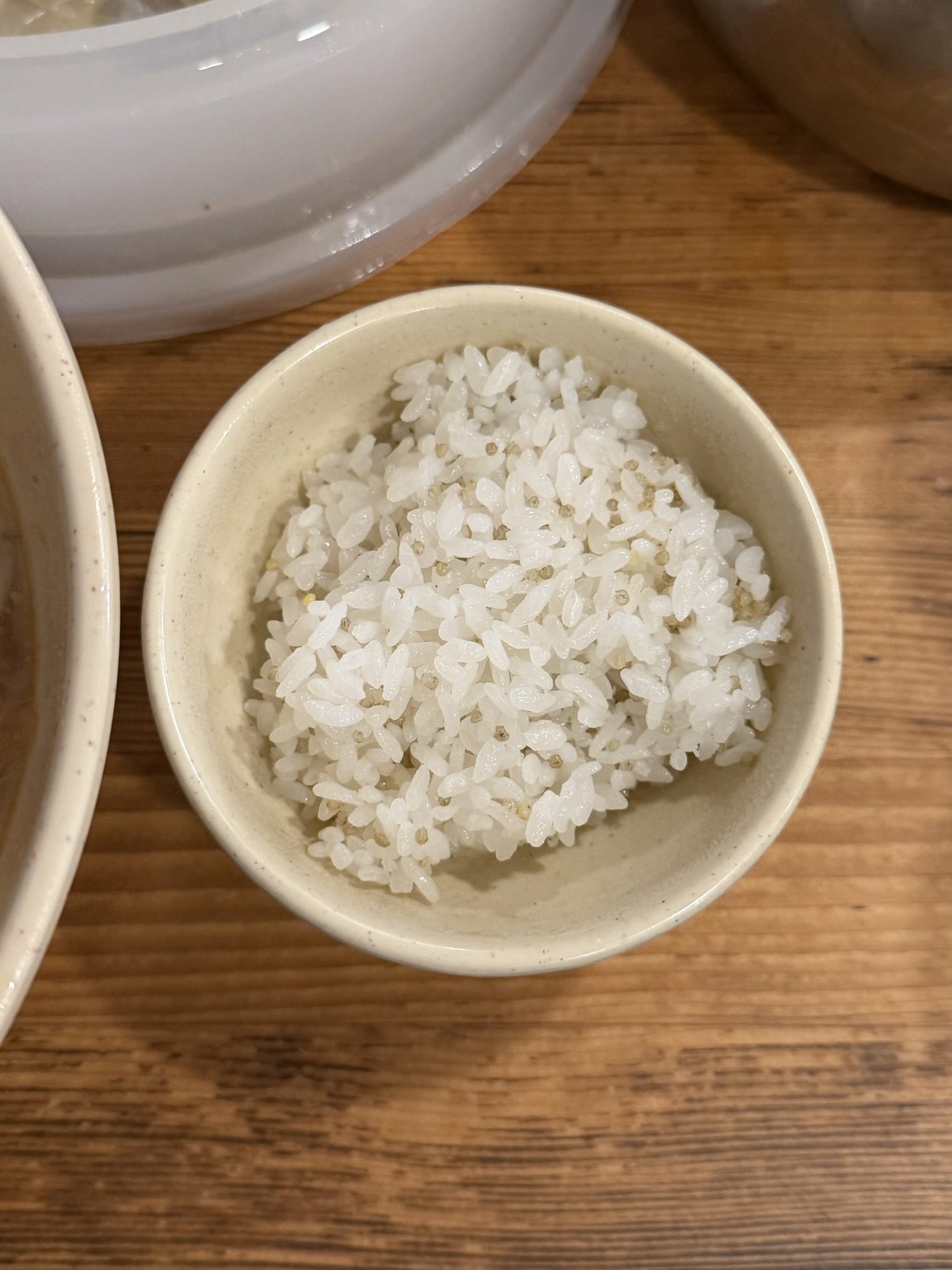
Then the rice. It comes in a small ceramic bowl, on purpose — it’s not a full meal portion, it’s a finishing-the-broth portion. Tip it into whatever broth is still left after the sari, stir, eat. By this point you will be unreasonably full, which is fine. I left a few spoonfuls of rice behind — there’s a sign asking you not to, and I felt vaguely guilty, but my stomach had decided. Lesson for next time: pace yourself for the third act.
What I’d do differently next time
Go to the Annex if you’re not committed to the original-branch atmosphere — it looks like a calmer meal. Order kalguksu, definitely. Skip the mandu plate unless someone in your group really wants it; the small mandu in the kalguksu is enough of a sample. Get sari, get rice, and don’t order before you’re ready to eat all of it.
And take the garlic kimchi seriously. Refill the dish. Try it on top of the noodles. That’s the meal.
Where to find it
Myeongdong Kyoja Main Branch (명동교자 본점)
Seoul, Jung-gu, Myeongdong 10-gil 29 (서울특별시 중구 명동10길 29)
Myeongdong Station (Line 4), Exit 8 — about 3 minutes walk. Euljiro 1-ga Station (Line 2), Exit 5 — about 7 minutes walk.
Open 10:30 AM – 9:30 PM daily. Walk-in only, no reservations.
Last verified: May 7, 2026. Menu prices photographed at the restaurant in May 2026.