We’d just come down off Inwangsan — Sunday afternoon, that perfect post-hike hunger where you don’t want a sit-down meal but you do want to eat something. Gwangjang Market (광장시장) is three subway stops east from the trailhead with one transfer (Line 3 to Line 1 at Jongno 3-ga), and it’s the kind of place where you can fill a craving for snacks without committing to a full dinner. So that’s what we did — wandered in around 3pm, picked a handful of things to share, and saved actual room for dinner later.
Quick disclaimer: this is a snack post, not a full Gwangjang Market guide. We skipped the famous sit-down dishes (yukhoe, kalguksu) because we knew dinner was a couple of hours away. What follows is just what we actually ate — and a couple of things I’d point you toward (or away from) if you’re only stopping in for an hour.
One note on prices: everything below is in Korean won (₩). For reference, ₩1,000 was about $0.73 when I published this — exchange rates shift, so use that as a rough guide.
Why Gwangjang is always packed
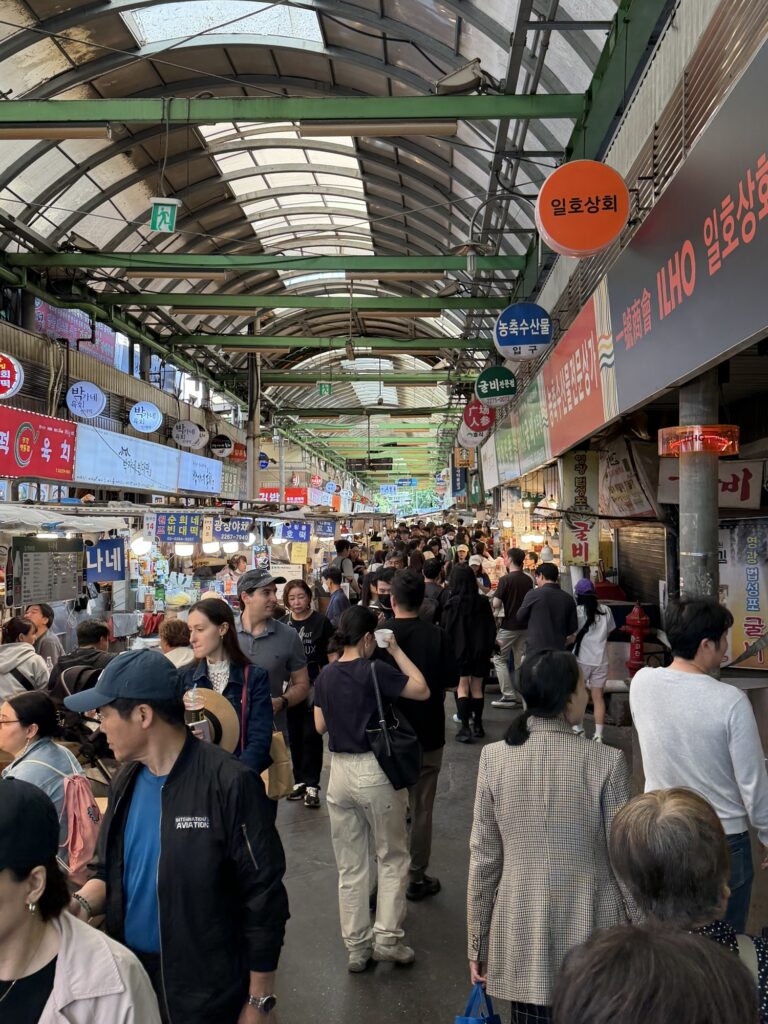
Gwangjang opened in 1905 and is one of the oldest permanent markets in Korea. The textile section (hanbok, fabric, bedding) is upstairs and on the perimeter, but the part everyone goes for is the food alley in the middle — open from morning until late at night, lined with stalls cooking bindaetteok (mung bean pancakes), grilling skewers, slicing raw beef yukhoe, and frying every kind of fritter you can think of. On weekends it’s wall-to-wall people. We came on a Sunday around 3pm and it was solid crowds the whole way through.
Garlic Boy — the Korean garlic bread the bakery show made famous
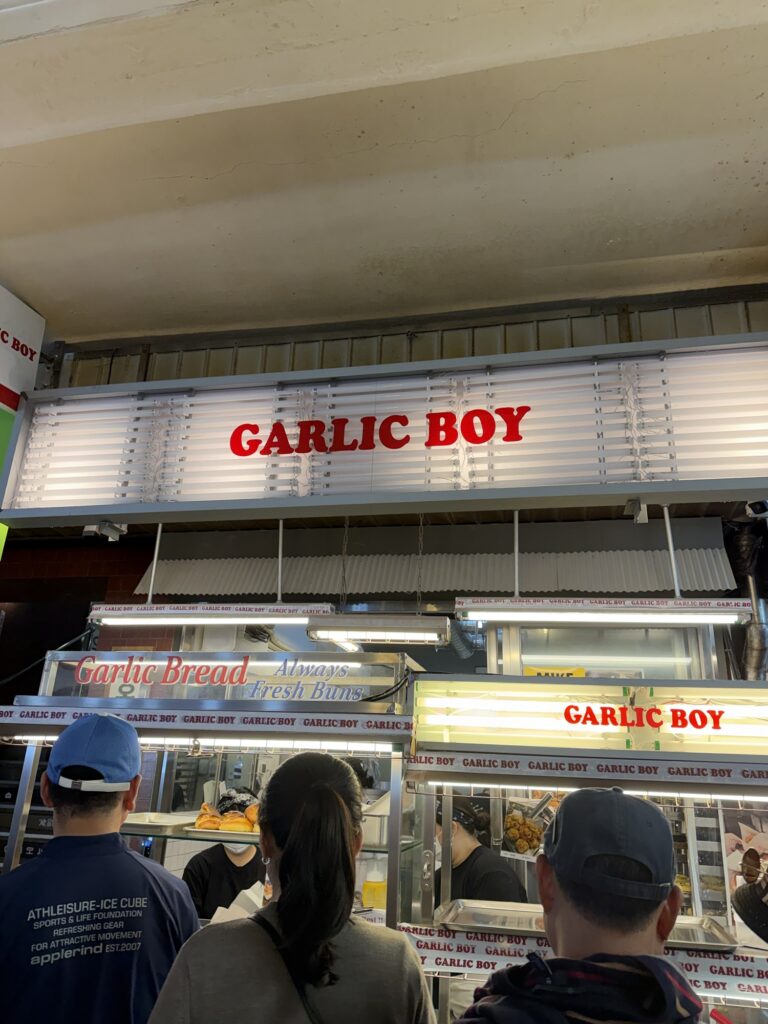
Garlic Boy (갈릭보이) is the bakery stall that blew up after appearing on a Korean baking survival show that aired earlier this year. The format was elimination-style, and Garlic Boy got cut early — but for whatever reason that’s when the lines actually got long. I’d heard the wait could push past an hour. We pulled up around 3pm Sunday and the queue was maybe six people deep. Decided to risk it.
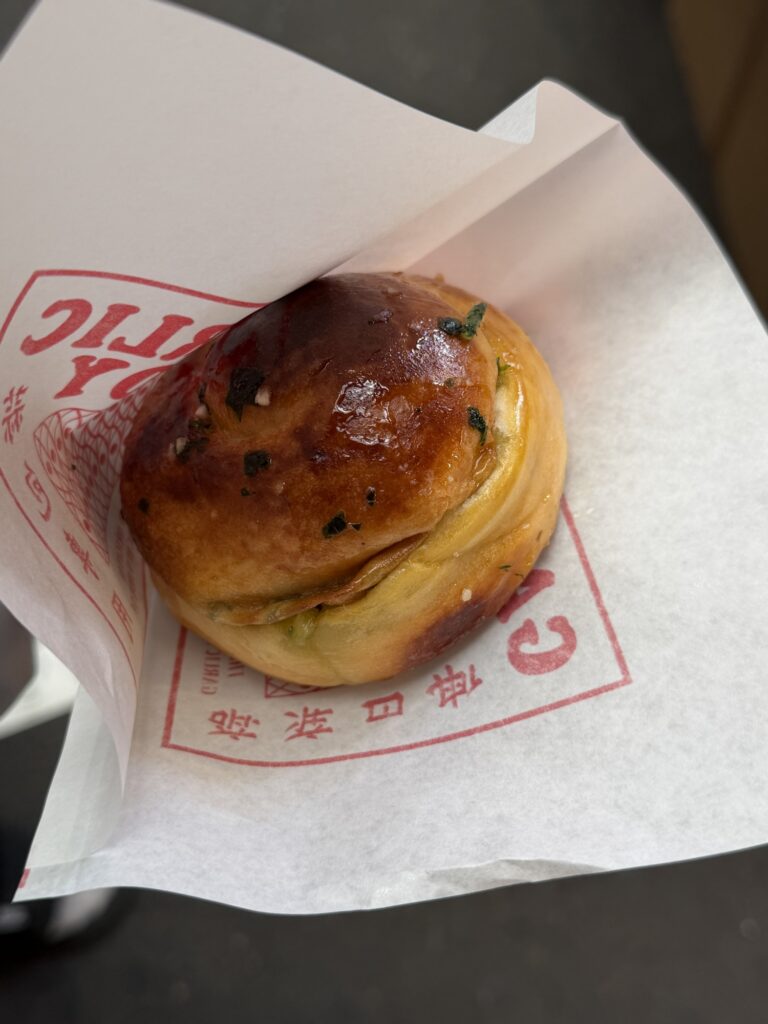
We ordered the basic Garlic Bread (₩3,900) — the cheapest thing on the menu, and what most regulars say is the one to start with. It’s about the size of a closed fist. The dough is enriched and soft, baked golden, and the top is brushed with a butter-garlic-parsley glaze that’s shiny enough you can see the light on it. They also do a Cheese Garlic Bread (₩6,200), Garlic Crumble (₩4,500), and a Truffle Cream version (₩5,300) if you want something fancier. This is a takeout-only stall — no seats, no tables — so plan to eat it standing or walking.
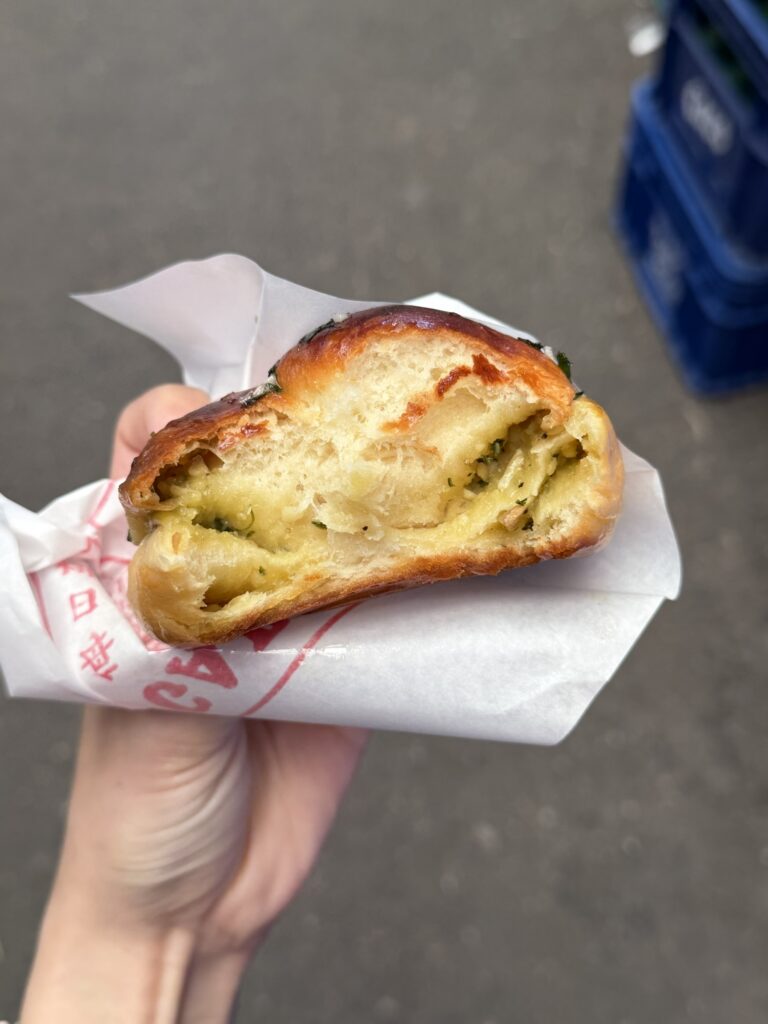
Honest take: it’s good, but it’s heavy. The garlic comes through plenty strong — no shortage of it — but the butter is what dominates and what eventually gets to you. Lots of butter. The bread itself is soft and slightly sweet, and the filling oozes out warm. One bun is plenty. We tore one in half between two people and that was the right amount — eat a whole one solo and you’ll start feeling coated by the third bite. If you’re rolling with a group, get one and split it, or get one bun and one of the savory options (cheese, ham-and-cheese) to balance out the richness.
Open Garlic Boy in Google Maps →
Fresh fruit juice — the simplest sip in the market
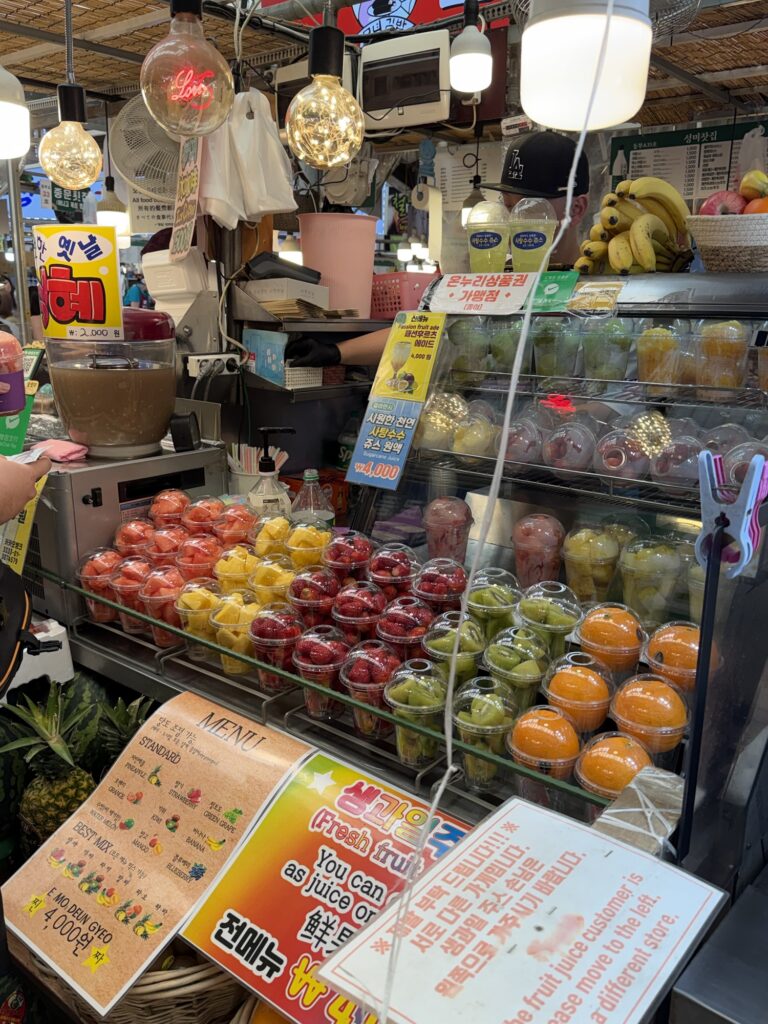
It was warm, we’d just eaten a butter bomb, and we needed something cold. The market has fruit-juice stalls roughly every 20 meters in the food alley. They all look basically identical — cups of pre-cut fruit lined up in the chilled display, a blender, a smiling vendor. Prices range from ₩4,000 to ₩6,000 for the same size cup and the same fruit selection, so do yourself a favor: walk a few more steps and find a ₩4,000 stall. There’s no meaningful difference.
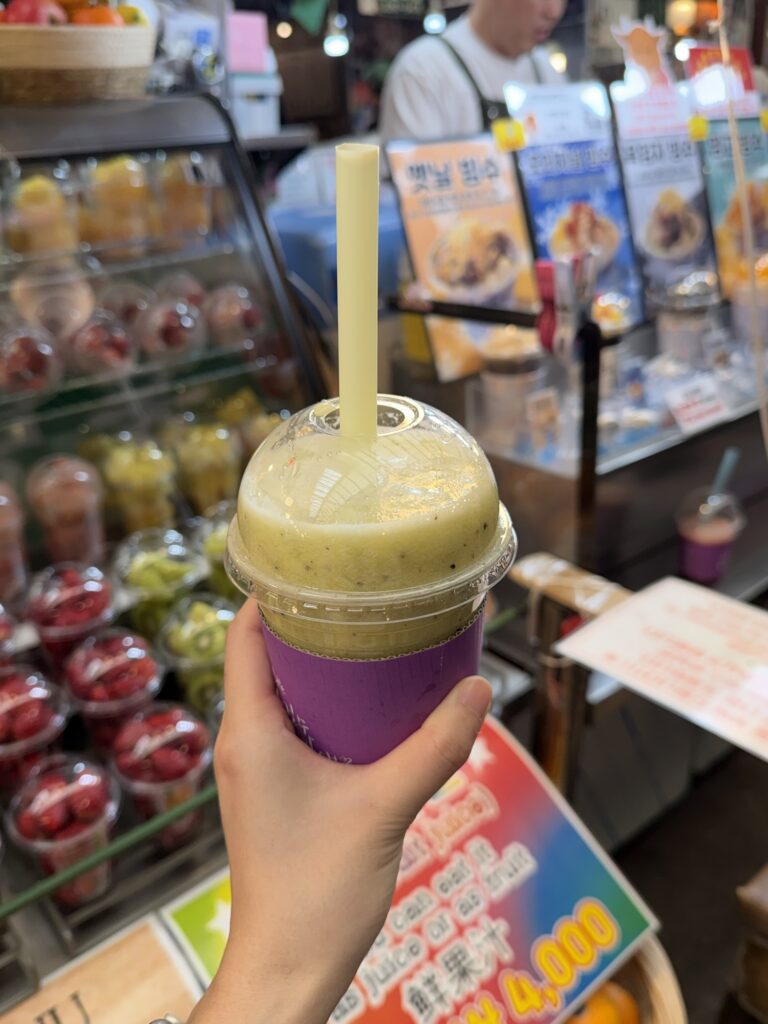
You pick one fruit or do a two-fruit combo at no extra cost. We went pineapple + kiwi, which came out a pale chartreuse and tasted exactly as bright and cold and sweet-tart as it looks. Strawberry season was mostly winding down but still on offer; mango, watermelon, dragon fruit, orange — all standard. If you’ve been eating heavy fried stuff (which, at Gwangjang, you basically will be), this is the reset button. Or just the thing to drink while you walk to your next stall.
Gwangjang Market Chapssal Kkwabaegi — the ₩1,000 donut everyone queues for
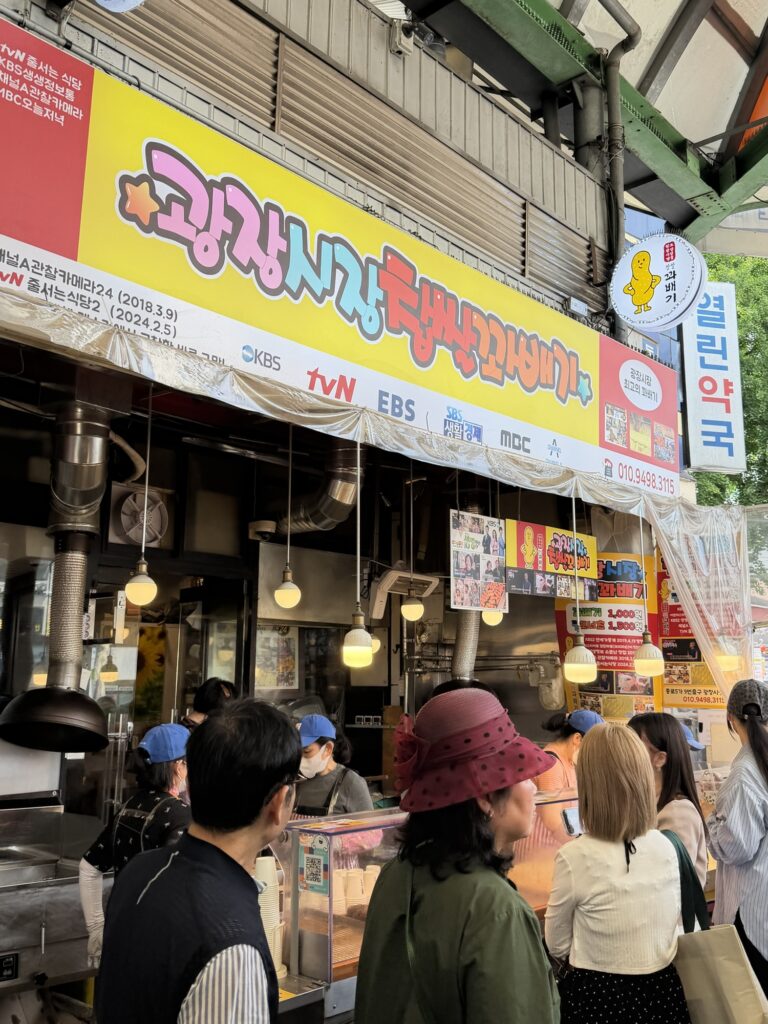
This was the one I actually came for. Gwangjang Market Chapssal Kkwabaegi (광장시장 찹쌀꽈배기) sits at the North #2 gate of the market and you can spot it from a block away — the signage is a riot of pink and yellow and the wall above the counter is plastered with logos for KBS, tvN, EBS, MBC. Every food TV show in Korea has filmed here at some point. The line was the longest I saw all day, easily 20 people.
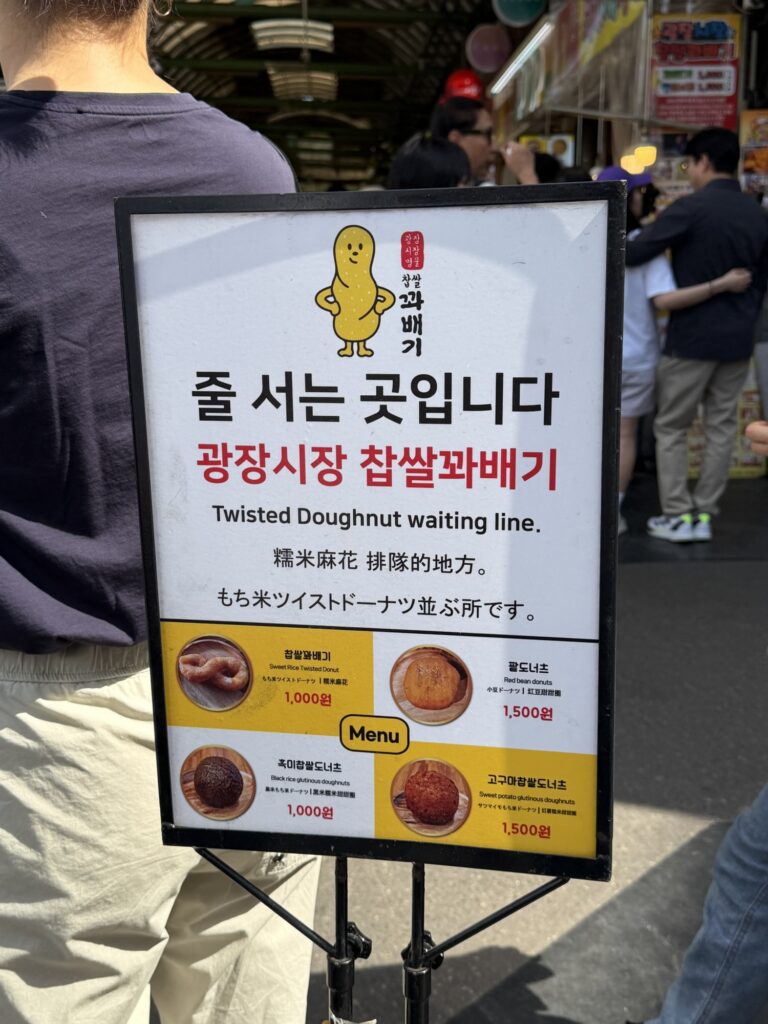
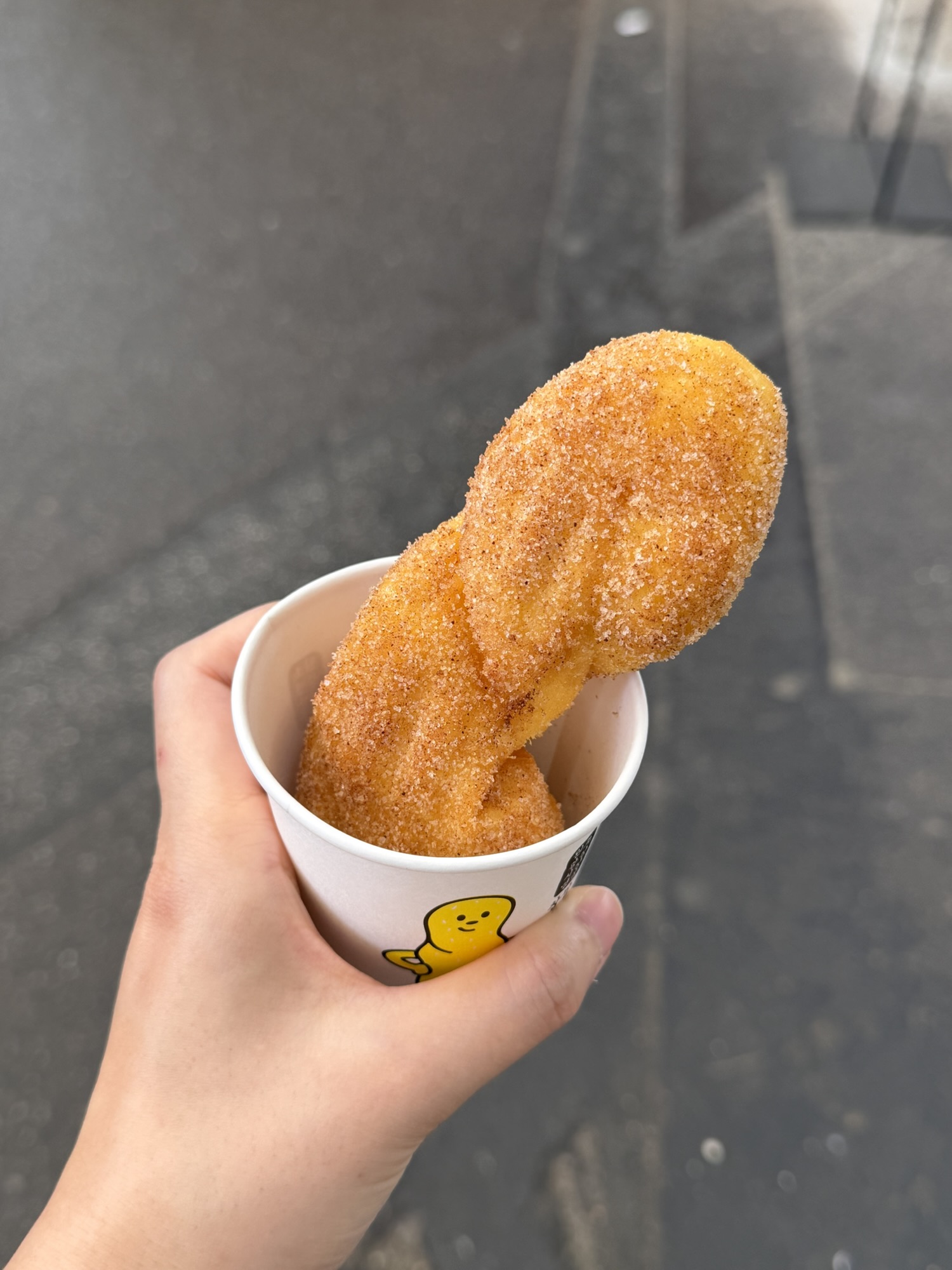
Don’t let the queue scare you off. It moves fast — we waited maybe 8 minutes total. They’ve got a multilingual sign so foreign visitors can find the back of the line, and the menu is short and clear: chapssal kkwabaegi (twisted glutinous-rice donut) ₩1,000, red bean donut ₩1,500, black-rice glutinous donut ₩1,000, sweet potato glutinous donut ₩1,500. Yes, you read that right — ₩1,000, less than a dollar. Get the original twisted donut. The others are fine but the twist is the one that built the reputation.
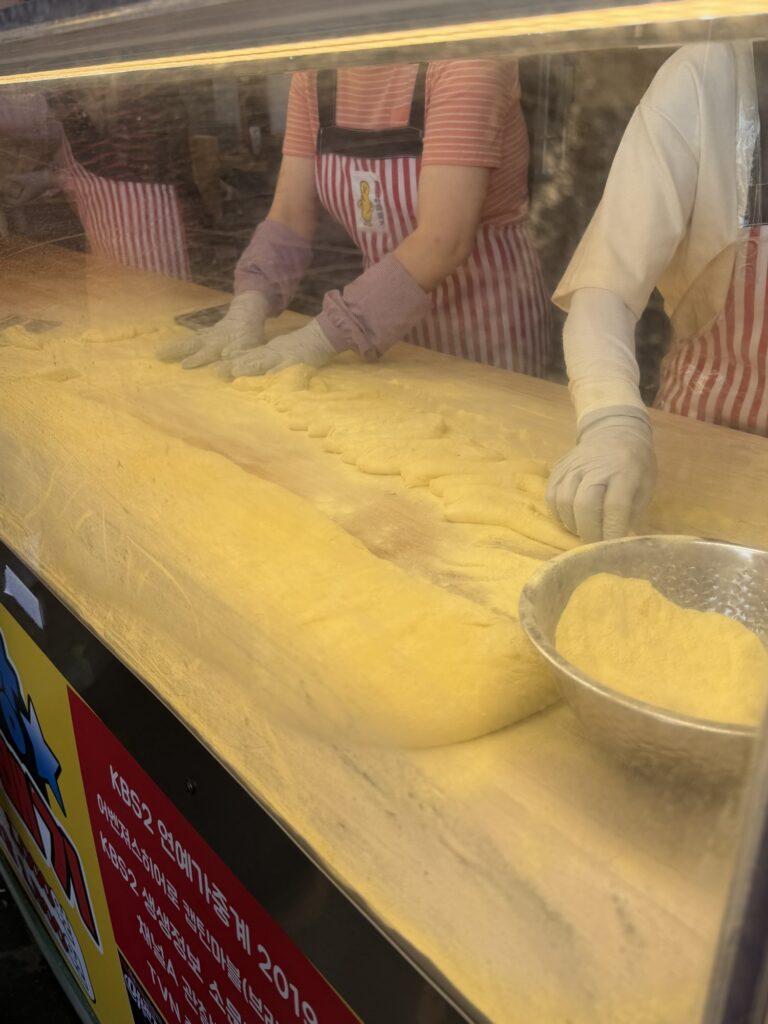
The reason the line moves: behind the glass, two workers are basically running a small factory. One pulls a long rope of yellow glutinous-rice dough; the other twists and portions. Then they go into the fryer in batches. Production never stops — that’s why you’re not waiting an hour for one donut.
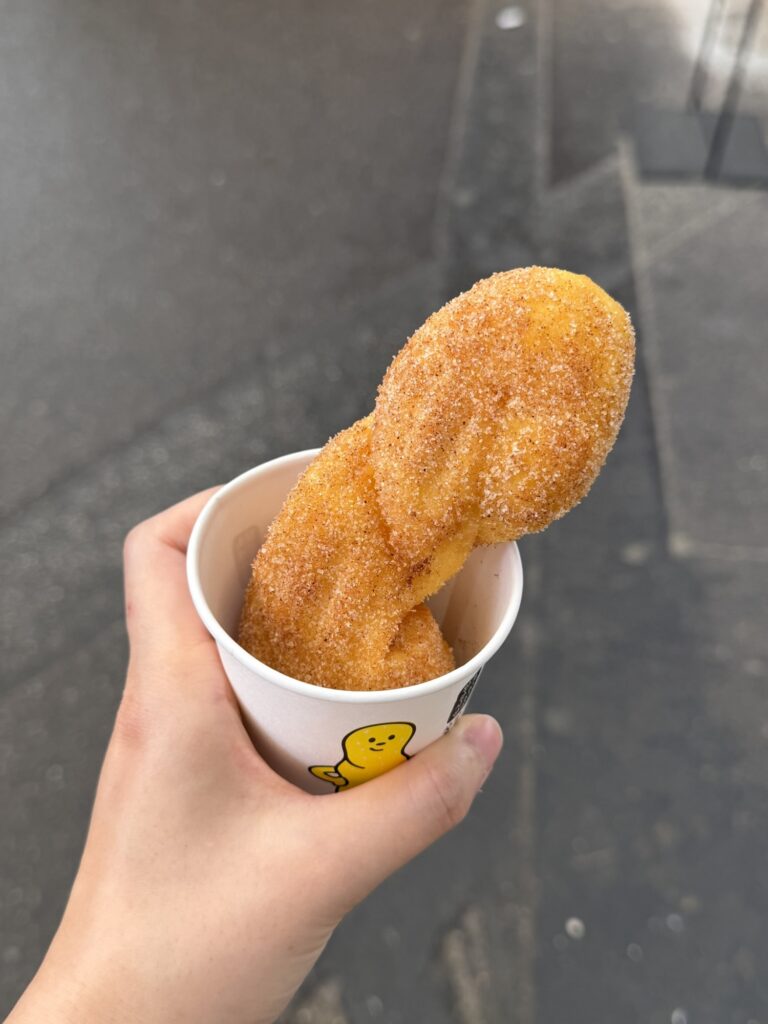
This is genuinely worth the line. The outside is dusted in sugar and cinnamon; the inside is chewy and almost cloud-soft from the glutinous-rice flour. Crisp at the edges where the sugar hits the hot oil, then tender all the way through. They’re not greasy, which is the trap a lot of fried things at markets fall into. One person, one donut. Don’t try to share — you’ll just be sad and get back in line. If you’re with two or three people, just order accordingly the first time.
Open Gwangjang Market Chapssal Kkwabaegi in Google Maps →
What we walked past — and the one I’d actually skip
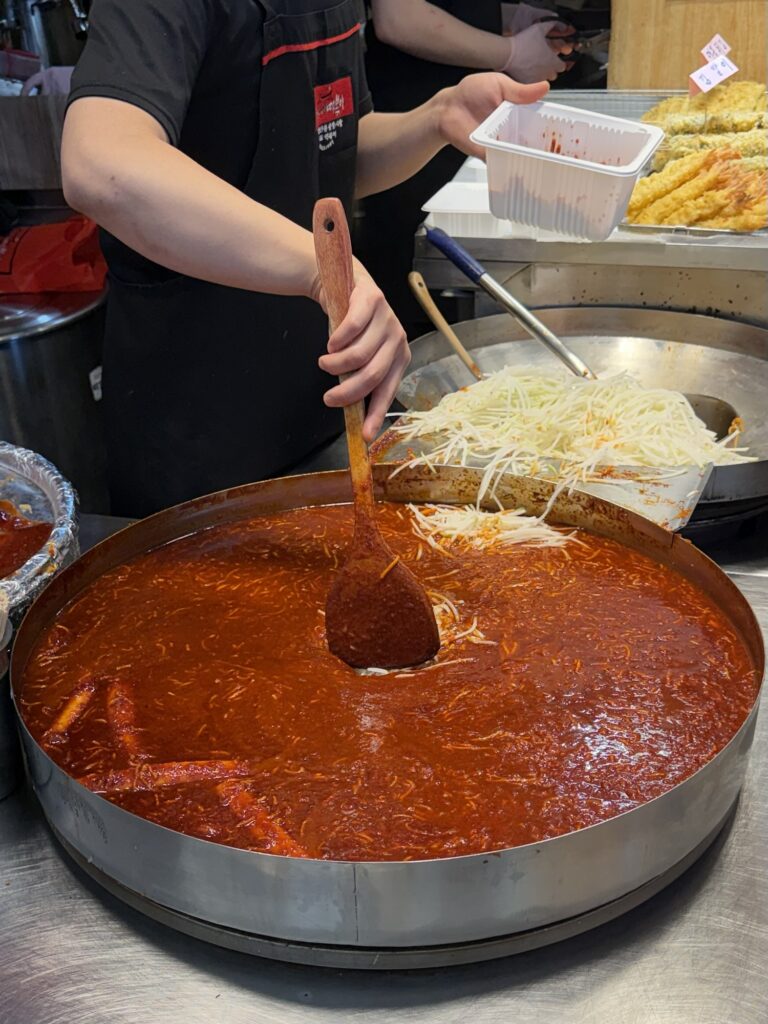
I’d been wanting to try this stall for ages — Busan-style tteokbokki with shredded radish on top. Visually it’s one of the more striking pans in the market: huge round griddle, the red gochujang sauce slowly bubbling, a mound of fresh Korean radish shaved in long white shreds across one side. The radish gets stirred in and softens against the heat. It’s a known stall and the photos online look excellent. Did not eat it this time — too full. Going back.
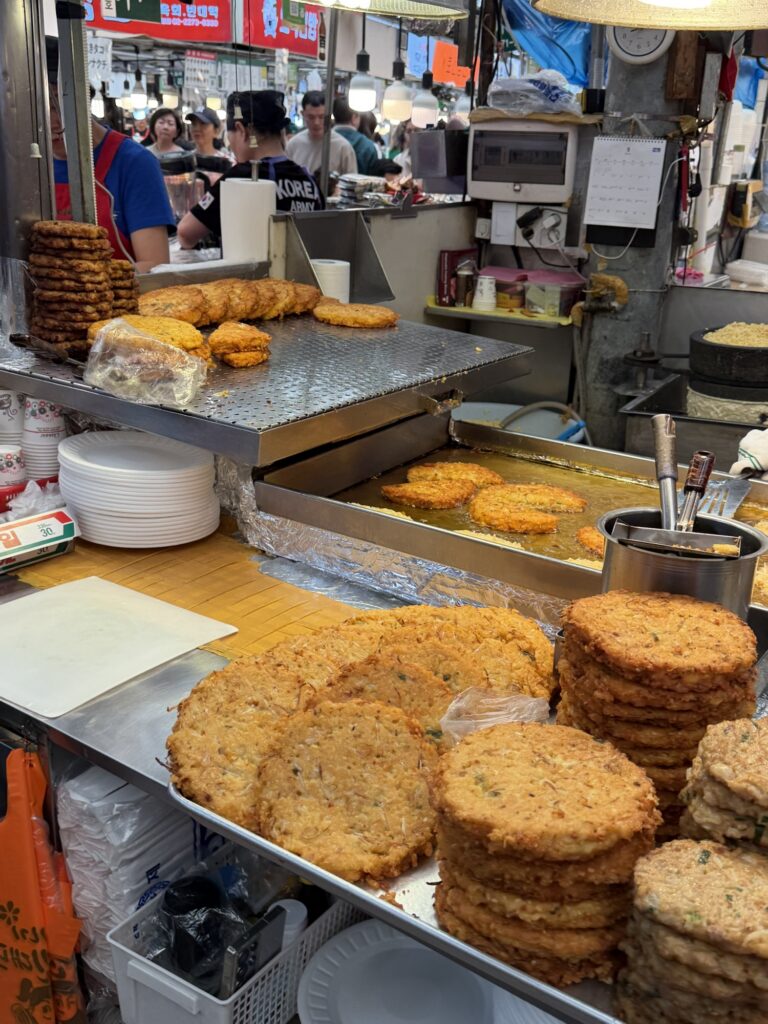
Now the hot take. Gwangjang’s most-famous food is bindaetteok — large savory pancakes made from ground mung beans, fried in oil until crisp at the edges. Every YouTube market video features them. Every list of “things to eat at Gwangjang” puts them at #1. I’ve had them at the famous stall here a couple of times, and honestly? They’re fine. They’re heavy, they’re oily, they’re decent with the dipping sauce — but the flavor doesn’t justify the hype or the price (they run about ₩6,000-7,000 per piece). If you’ve never had bindaetteok before and want to check the box, go for it. If you have a limited stomach budget at the market, I’d put it well below the twisted donut and the garlic bread.
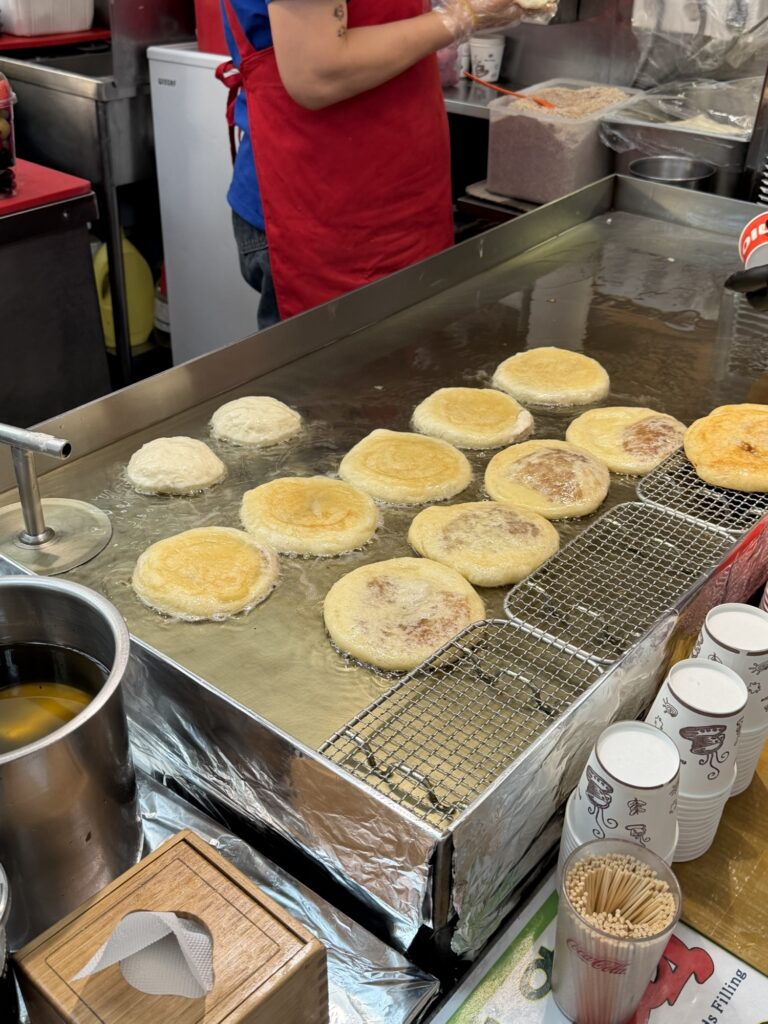
I do not skip hotteok (Korean sweet pancakes — pan-fried dough stuffed with brown sugar, cinnamon, and crushed nuts that melts into a syrup when it’s hot). Ever. Except this time, because I was already too full. The stall was on a flat griddle pressing out about a dozen at a time, golden-brown and steaming. If you have any stomach space left when you get to one, use it.
One thing worth taking home
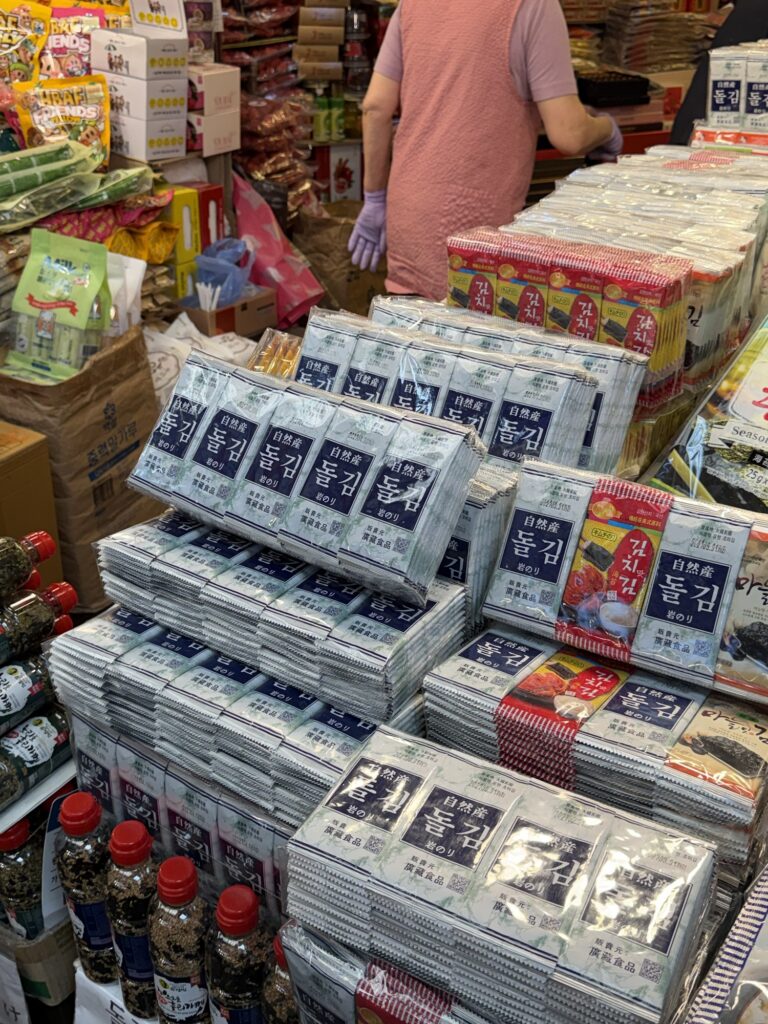
The market has whole sections of dried goods and souvenirs along the perimeter. The one I’d actually call out: packaged seasoned gim (Korean roasted seaweed snacks). It’s gone weirdly trendy as a snack abroad in the last couple of years, and it’s genuinely good — crispy, salty, sesame-oil-scented. The Gwangjang vendors have stacks and stacks of it, often in family-pack boxes. One thing to watch: prices vary a lot stall to stall, and tourist-area markup is real. Walk past three or four sellers before you buy, and check the per-pack price (not just the box price).
Quick notes if you go
Subway: Jongno 5-ga Station (종로5가역) on Line 1, Exit 8. Less than a minute to the market gate.
Best time to come: Weekday late morning if you hate crowds. Otherwise expect a wall of people on weekends from late morning onward.
Payment: Most stalls take card and Korean QR pay now. A few small fritter stands are still cash-only — keep ₩5,000-10,000 in cash just in case.
Seating: Limited and competitive at the sit-down stalls. For snack stalls like Garlic Boy and the donut place there’s no seating at all — eat standing or walk and eat.
This is a snack visit. If you want a sit-down meal at Gwangjang, the move is yukhoe (raw beef tartare) at the dedicated alley on the east side, or a bowl of kalguksu. Different post.
Nearby if you want to keep walking: Cheonggyecheon Stream (청계천) is a 3-minute walk south — the elevated highway that ran here was torn down and the stream restored in 2005, and the recessed walking path through the middle of the city is especially nice in the evening. Ikseon-dong (익선동), a restored hanok alley packed with cafés and small bars, is about 10 minutes west on foot. Jongmyo Shrine (종묘), a UNESCO site with the Joseon royal ancestral hall, is also about a 10-minute walk from the market. Dongdaemun Design Plaza (DDP) is one subway stop away on Line 1 (Dongdaemun Station, then a 5-minute walk) if you want a contrast.
Where to find Gwangjang Market
Gwangjang Market (광장시장)
88 Changgyeonggung-ro, Jongno-gu, Seoul (서울 종로구 창경궁로 88)
Jongno 5-ga Station (Line 1), Exit 8 — about a 1-minute walk.
Open access, no entrance fee.
Open Gwangjang Market in Google Maps →
Last verified: May 18, 2026.
Leave a Reply